
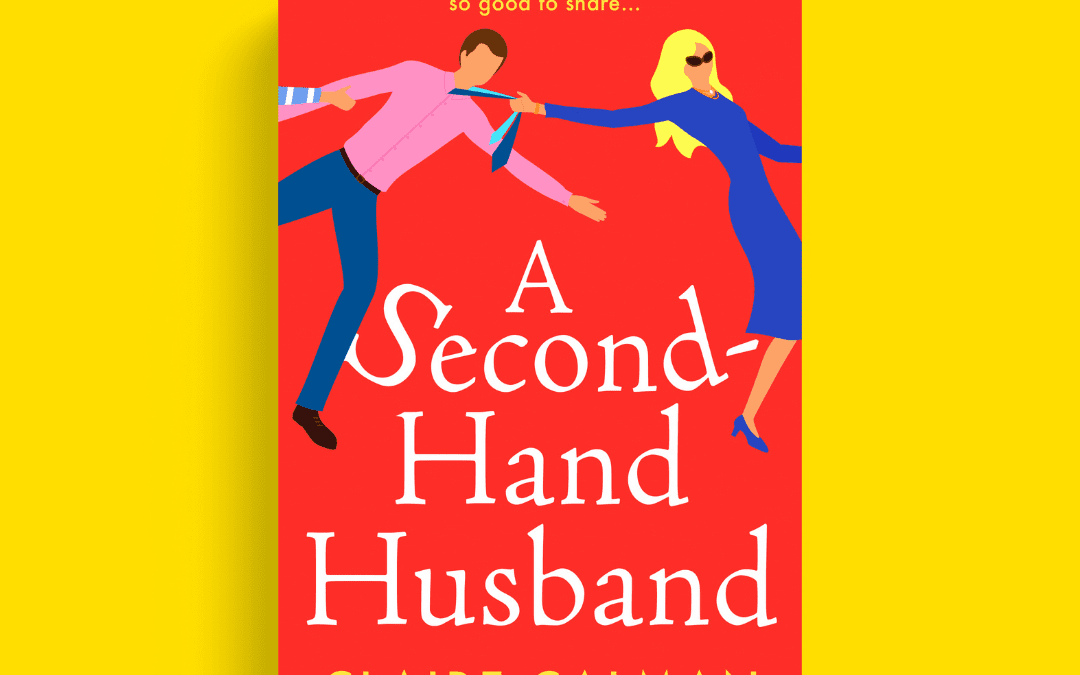
A Second-Hand Husband by Claire Calman is out now!
🇬🇧 https://amzn.to/31UuaeE 🇺🇸 https://amzn.to/2OrMJn5
Writing is a very peculiar way to earn a living. You get up each morning and go
to your laptop (or your notepad and pen if you’re old school, like I am) and you
start weaving a story out of nothing, like a spider spinning a web out of silk. Of
course, you’re not really starting with nothing; it just sometimes feels that way
to me when I look at the empty page of my notepad and think, ‘Ok, now
what?’ With each novel I write, I find myself drawing on all sorts of things from
yesterday, last month or twenty years ago: personal experience, things friends
have told me, tiny snippets I’ve overheard in a shop or a café. In addition,
there are elements that seem to descend out of nowhere, perhaps a strange
synthesis of imagination and long-forgotten memories, and it is these bits that
always feel slightly magical.
Writing fiction necessitates your having to put yourself in someone else’s
shoes, someone else’s head. I rarely find writing easy – I’m too easily
distracted, like a toddler, so have to force myself to be disciplined and to focus
rather than gazing out of the window all day. The engineering side of
constructing a novel can be very challenging, having to make the structure
work so that the story flows well and draws the reader in and offers shifts in
pace and mood. But one of the elements I always love is conjuring up my
characters. After a while, if you’ve really thought about them (I have pages and
pages of background notes), they start to feel as if they’re living their lives
according to their own lights rather than yours, and that you are not simply
manipulating them around the stage like stiff puppets but observing them and
recording what they say and do.
I also like taking a situation I’ve been in myself, say, being a step-child and
growing up in a step-family, but then imagining it from a completely different
viewpoint (as well as changing the circumstances and the story). So ‘A Second-
Hand Husband’ gives us, not the step-children’s view, but the new step-
mother’s view. My heroine is Natalie and, from writing through her eyes, I’ve
grown to love her. She’s quite tough and scrappy. She feels completely over-
shadowed by her husband’s first wife, the glamorous, well-groomed Antonia.
I’m not Natalie at all, really I’m different in a thousand ways, but I’m quite
scruffy and usually in jeans and t-shirt so I can imagine how it might feel to be
Natalie, how she might really worry that she doesn’t measure up to the
exacting standards set by Antonia, Wife Number One.
I used to live in a village in Kent and I enjoyed giving my novel a village setting.
I love villages, and that feeling of belonging to a community, but there can be a
downside – for example, the fact that you bump into people you know all the
time. That’s lovely and sociable, but it can also be a bit claustrophobic if you’re
not used to it. My heroine Natalie starts to feel like a frightened rabbit having
to pop up quickly out of her burrow, hoping she won’t get spotted by Antonia.
I really enjoy writing about relationships, that delving into the dynamics of how
people are with each other, looking at the tensions and areas of imbalance, the
dances we all do around each other, whether that’s in a marriage, or between
ex-partners, siblings, parents with their children, or grown-up dealing with
their own elderly parents.
I hope you enjoy reading the book – it’s a pandemic-free zone, so forget about
the world for a few hours and curl up with a nice big mug of tea or a generous
glass of wine and sink into the world of A Second-Hand Husband…