
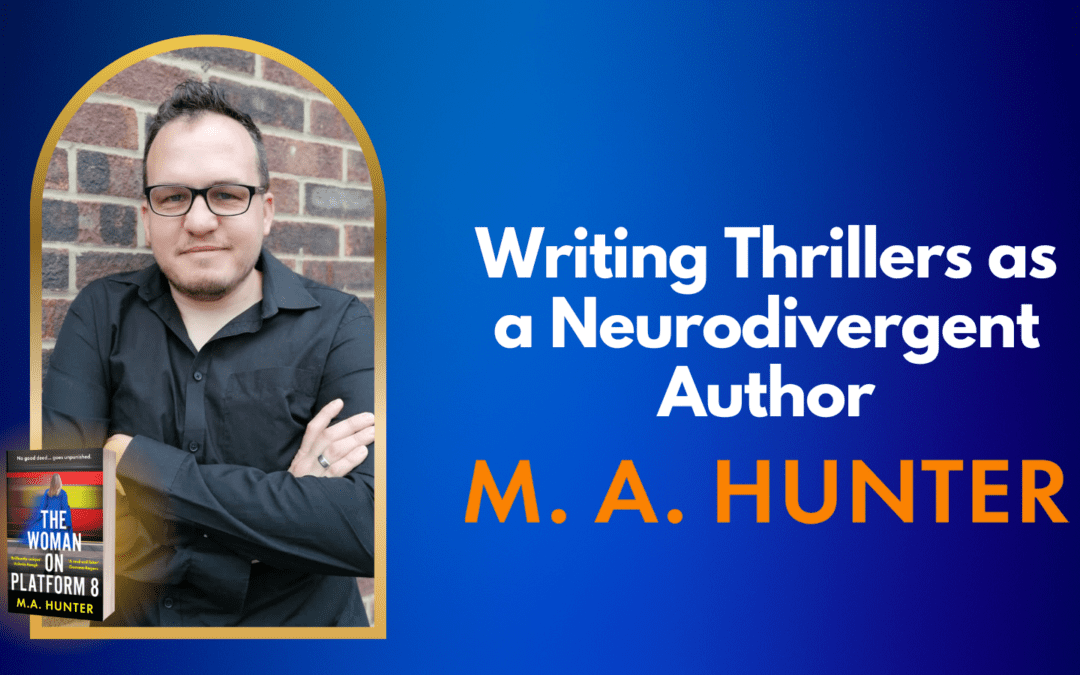
The Woman on Platform 8 by M. A. Hunter is out now – get your copy 📖
In the last 15 years I have written over thirty full-length novels, with my 27th, The Woman on Platform 8, set to be published on 31 March 2025. I’ve topped the Kindle charts, made enough in royalties to require annual self-assessment with HMRC, and attended various writing festivals. In addition, I have a full-time job, a mortgage, and I am married and have two children. If you were asked to imagine what a neurodivergent character looked like, I wouldn’t fit that mould. But in the last two years, I have been formally diagnosed as Autistic and with Attention Deficit Hyperactivity Disorder (ADHD).
It is estimated that more than one in seven people in the UK is neurodivergent***, and that number is increasing year-on-year as more become aware of the common traits and challenges that exist for those born with that neurotype. The volume of people seeking assessment and diagnosis for these conditions is also increasing with NHS waiting lists years long in some parts of the country.
Autism and ADHD are both recognised as disabilities in the UK because of the significant, lifelong challenges inherent with these neurotypes: communication difficulties; staying focused; easily distracted; hypersensitivity to stimuli and perceived rejection; requiring routine. Becoming a professional writer would appear to be a poor choice for someone with such struggles.
I can quickly become overwhelmed by unclear communication, changes to my routine, and am hypersensitive to noise and light. Attending writing festivals where I’m expected to socialise with other authors in loud and confined spaces fills me with dread and leaves me wiped out for weeks, which is why I’m very particular about where and when I attend festivals. Conversely, I love being on and moderating panels in front of a large audience, and you can’t do one without the other, so ‘small talk’ becomes a necessary evil despite how much of a challenge it presents. And don’t get me started on how I feel physical pain when I read bad reviews of my books.
Yet, I am a better writer because of the differences in how my brain processes information. Alone in a room with just a keyboard and my playlist and I come alive.
Authors often ask one another how long it takes them to write a submission-ready manuscript, with the average Sunday Times Bestseller committed to one book a year. I always dread the question because when I admit to writing 2 – 3 books per year despite my full-time (and fairly senior) job, their faces drop. They can’t understand how it is possible, but I write about two thousand words in a little over an hour each morning before I start work and produce a decent first draft within nine to ten weeks. As you might already have guessed, I am a plotter.
I consider myself extremely fortunate to have a vivid imagination; all my primary school reports stated as much. It means I have new ideas for books all the time. Once my agent and editor have helped me choose which idea to pursue, I’m able to map out the story, scene-by-scene, like watching a Netflix drama on a screen in my head (I even picture the actors who would be used in the potential television adaptation). I write bullet points of what happens in each scene / chapter as I go, and when it comes to writing they serve as a reminder of what happens in the scene and all I have to do is describe what I’m seeing on the screen in my head. During that period, I’m able to shut out the real world with music pumped through noise-cancelling headphones, and hyperfocus on the story.
My new book is my first to feature an openly autistic character, because there are not enough openly autistic characters accurately portrayed in literature at present, and I not only want to raise awareness of divergent neurotypes, but also to encourage acceptance.
I have spoken to other authors about my writing process, and many resonate with my experience. I’d go so far as to say that there are probably more authors with neurodivergent minds than not. Our need to create stories to entertain is deep-rooted in our DNA; it’s what we were born to do. If you can find the environment that works for you, you might be surprised how productive you can also be.
M.A. Hunter is the pen name of Stephen Edger. He writes psychological thrillers for Boldwood Books and The Woman on Platform 8 is published in ebook, paperback and audio book on 31 March 2025. M.A. Hunter will be appearing at CrimeFest Bristol in May 2025.
*** Local Government Association