
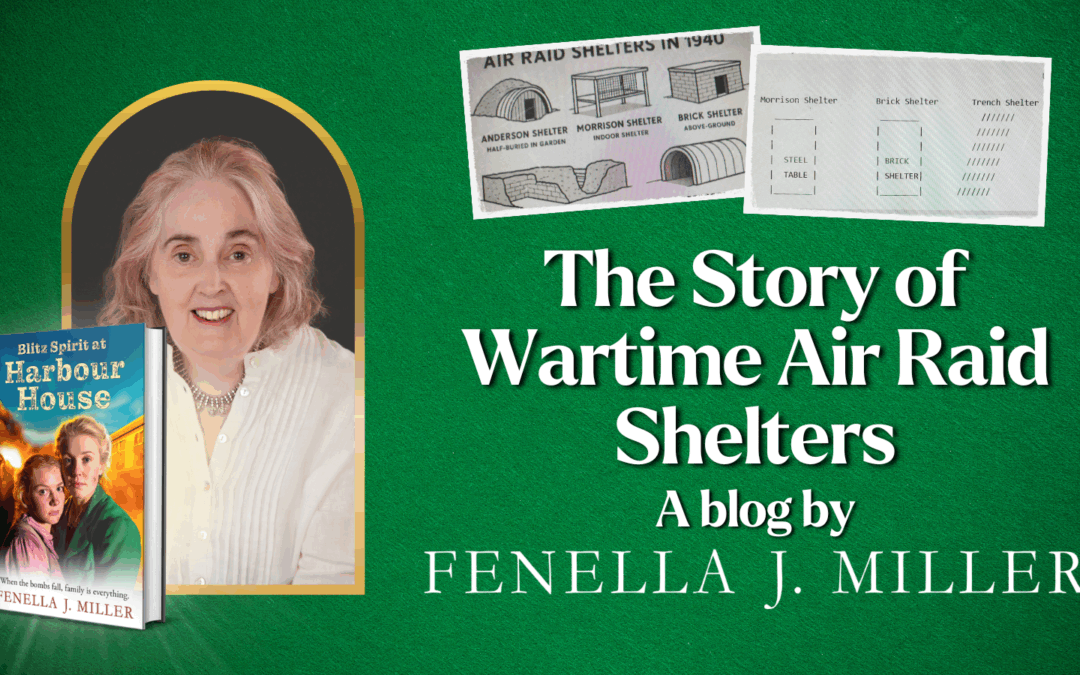
In nineteen thirty-nine when war broke out the government had already started providing air raid shelters for their civilians. There was an Anderson shelter, Morrison shelter, A surface brick and concrete shelter, basements and cellars, trenches, the London underground stations and other tunnels.
The Anderson shelter was designed for families with gardens. It had a corrugated galvanised steel sheet which was half buried in the ground and then earth was piled on top. It held 4 to 6 people – though more if they squeezed together. It was issued free if you earned less than £250 a year and cost £7 if you earned more.
The Morrison shelter was for families without gardens and was introduced in March 1941 but designed in 1940. It was an indoor shelter which looked like a steel table with mesh sides, people sheltered underneath on blankets and mattresses during raids. It would hold two adults and two children. It would protect against falling debris if a house collapsed but wouldn’t be much use if the house got a direct hit. People liked it because it could be used as a table.
The surface shelter made of brick and concrete was known as the Sandwich shelter. This was because they built in many of them such a hurry they often didn’t get enough reinforcement or concrete. Therefore, if the shelter got a direct hit the walls blew out and the concrete roof collapsed onto the concrete base sandwiching the unfortunate occupants and killing all of them. They could hold between twenty and fifty people and were useful against shrapnel a minor blasts. The problem was that after a few tragedies people were reluctant to use them and I don’t blame them.
Basements and cellars were often used by those who lived in the bigger more expensive houses. In towns without spaces for gardens or shelters these were all that were available. Factories, shops and hotels had them and they were fine unless the large building above collapsed.
Trenches were built in public parks, school grounds and communal areas. They were zig-zag or dog-leg trenches, often reinforced with corrugated iron and timber and then covered with earth. They could accommodate dozens of people. They were all right in an emergency but were liable to collapse and flooding. They only offered protection against shrapnel and bomb blast. They had them on army bases, RAF bases and so on.
London underground stations and other tunnels were adapted as shelters and later on in the war fitted with bunks, medical posts and toilets. The capacity for those was thousands and they were very effective against all but the heaviest direct hits. Ramsgate built an underground town for their residents and although many buildings were bombed and destroyed very few people were injured or killed. Contrary to popular belief only about 5% of Londoners used the underground tunnels.
In Wivenhoe where Harbour House is set they did have a shelter for the schoolchildren, and two others, but mostly people didn’t bother. There were no bombs dropped and civilians carried on as usual.
Fenella J Miller