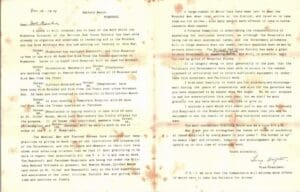

This remarkable letter from December 1914 offers a real-life glimpse into the wartime efforts that inspired The Lifeboat Girls at War, bringing to life the vital work of Dorset’s Red Cross volunteers, the transformation of grand houses into hospitals for wounded soldiers, and the extraordinary women who stepped forward to help, including the real-life Lucy Wright and Mrs Bankes, who feature in the novel.
December 16th 1914
Henbury Manor,
Wimborne
Dear Mrs Bankes,
I think it will interest you to hear of the work which the Wimborne Division of the British Red Cross Society has been able already to organise and undertake in rendering aid to the Wounded and the Sick Soldiers who are now serving our Country in this War.
Dorset 6 (Wimborne) has equipped Beaucroft, and this Hospital is now in use with 40 beds for Sick from the Troops quartered in Wimborne. Later it is hoped this Hospital will be used for WOUNDED.
Dorset 12 (Sturminster Marshall) and Dorset 52 (Cranborne) are working together at Newton House in the care of 15 Wounded and Sick Men from the front.
Dorset 74 (Lytchet Minster) and Dorset 48 (Hampreston) have been busy with Wounded and Sick from the Front ever since November 2nd. 32 beds are now occupied in the Hospital in South Lytchet Manor.
Dorset 48 is also opening a Temporary Hospital with 24 beds for Sick from the Troops quartered at Ferndown.
Dorset 60 (Woodlands) is hoping shortly to open with 20 beds at St Giles’ House, which Lord Shaftesbury has kindly offered for the purpose. It is hoped that individual members from Dorset 44 (Witchampton) and Dorset 100 (Handley) will be able to work in one or either of the V.A.D. Hospitals.
The Medical Men and Trained Nurses have incurred our deep gratitude by giving so much time to the instruction and preparation of the Detachments, and the Officers and Members in their turn have shown such unfailing interest that we feel it most gratifying to be able to report that practically all the V.A.D.’s are now at work. The Beaucroft and Ferndown Hospitals are being run under the Military Medical Officers at present, but Newton House, Lytchet Manor (and later on St Giles’ and Beaucroft) rely on the kind supervision and assistance of the local Civilian Doctors who are giving their time and services so freely.
A large number of Motor Cars have been lent to meet the Wounded Men when they arrive at the Station, and later on to take them out for drives; also many people have offered to take in convalescents when needed.
A Finance Committee is undertaking the responsibility of appealing for continued donations, as although the hospitals are being run on most economical terms, and the Government allowance will in large measure meet our needs, certain expenses must be met by private donations. The British Red Cross Society has made a grant to each Detachment on starting work, and will, if possible, help further by gifts of Hospital Stores.
It is largely owing to your generosity in the past that the Voluntary Aid Detachments have been able to attain to the needed standard of efficiency and to obtain sufficient equipment to undertake this excellent and Patriotic work.
I wish most heartily to thank you for your help and encouragement during the years of preparation and also for the generous way you have responded to my appeal when War began. We do not propose to ask for subscriptions this next year, but we shall be most grateful for any help which you may like to give us.
I enclose a card which will admit you to any of the Voluntary Aid Hospitals in the Wimborne Division and ensure that you may be welcomed to see the result of your long-sustained assistance in the past.
The most convenient visiting hours are as a rule 2-4pm.
May I ask you to strengthen the hands of those in authority at these hospitals by every means in your power? The burden is by no means light and interest, sympathy and encouragement go far to uphold us in this time of strenuous work.
Yours sincerely,
Lucy Wright
Vice-President
PS – I am told that the commandants will welcome more offers of motor cars to take the Patients for drives.