A blog by bestselling author Jane Dunn ✨ A Scandalous Match is out today!
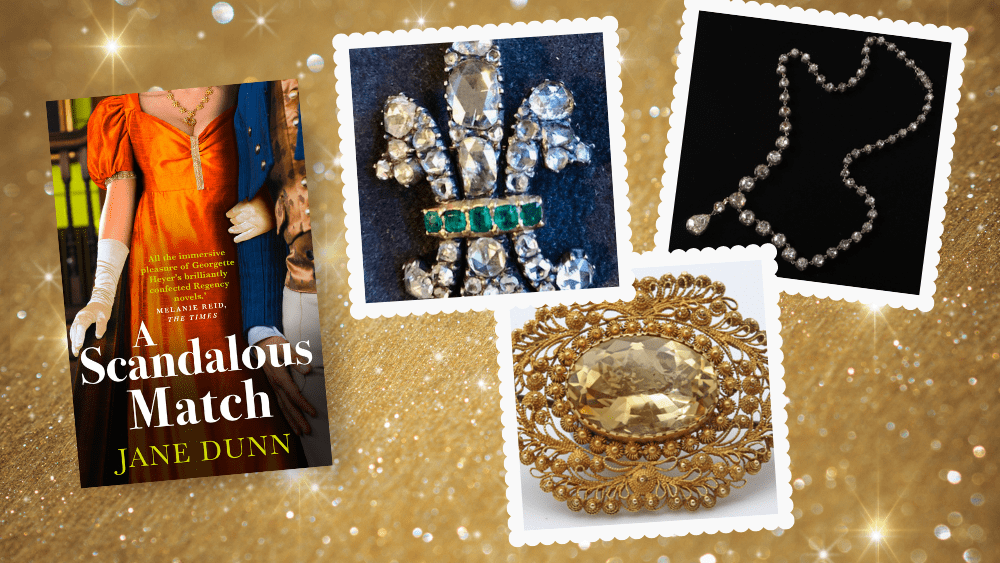
In A Scandalous Match an ancestral diamond necklace plays an important emotional part. My actress heroine, Angelica, is given what she believes is her grandmother’s favourite diamond rivière – a necklace of graduated gemstones – and as she has never known any family beyond her mother her heart is touched. It is her most precious possession and when it is snatched from her neck dramatic consequences follow.
Georgian jewellery is particularly attractive with very much a hand-crafted look. Of all the precious metals, silver was the most often used, although gold and a cheaper alloy of zinc and copper called pinchbeck will also be found.
Since ancient times diamonds were considered to be somehow magical and talismanic but it was only in the 16th century when tools were invented to cut them accurately that they became more widely used in jewellery. In modern times the Brilliant cut for diamonds has become the most popular for its many facets which give a brilliant sparkling effect, but Georgian diamonds are mostly Rose cut. This is where the diamond has a flat bottom and the facets rise to a soft pyramidical point. The light from Georgian diamonds is soft and romantic, very different from the bright scintillation of the Brilliant cut.
Another distinctive attribute of Georgian jewellery is that the settings of gemstones are closed at the back, often ‘foiled’ where a metallic coating is applied to the back of the gem to increase the sparkle. During the Georgian, Victorian and Edwardian eras a glamorous present to a wife or mistress was a ‘parure’, a set of necklace, earrings and bracelet and/or brooch, meant to be worn together. In A Scandalous Match, Angelica’s nemesis is The Duchess who very much favours magnificent ancestral parures which she wears by day or night.
The Napoleonic Wars 1803-15 were responsible not just for terrible suffering and the carnage of men and horses but also for a scarcity of gold and gems. During this time Cannetille became fashionable. This involved gold wires intricately wrapped to create ornate and delicate jewellery which was highly decorative but used less of the precious metal.
Writing about the Regency and loving jewellery all my life it was inevitable that I should be desperate to have a piece to wear myself. I bought at auction a small fleur de lis made of rose cut diamonds and tiny emeralds, obviously part of a larger piece, possibly a tiara. But it transports me back to the early 1800s and I love it. In the photograph (much enlarged) you can clearly see the rough imperfection of the making, so characteristic of the period. Thus special jewels are loved, handled, worn and passed on to the next generations – and so they survive down the centuries.