
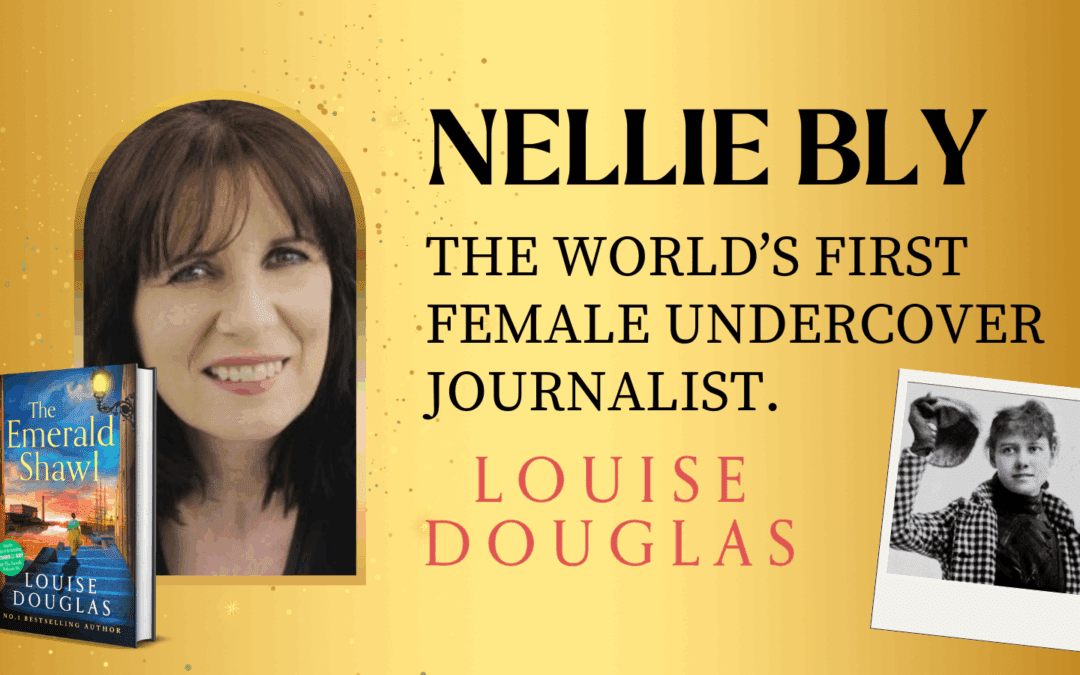
Nelly Brooks, in The Emerald Shawl, is a fictional, British, woman reporter, but every aspect of her story was inspired by the American Nellie Bly (1864 – 1922), probably the world’s first female undercover journalist.
It was Nellie Bly (real name, Elizabeth Jane Cochran) who famously feigned madness so that she would be committed to a women’s asylum in New York. Her report of the cruelty and abuse she witnessed within its walls was the catalyst for sweeping reforms in the treatment of the mentally ill.
A second, huge achievement was that Nellie Bly pioneered the way for women writers to investigate subjects besides recipes and household tips.
One of fifteen children, she dreamed of being a writer and was infuriated by articles published in her local Pittsburgh newspaper that were written by popular columnist Erasmus Wilson, a celebrity of his time. He regularly pontificated that the main purpose of girls was to have babies and look after the home. He wrote that the working woman was ‘a monstrosity’.
Eventually, the young Elizabeth was driven to write a stinging response, and the editor was so impressed by her spirit and intelligence that he hired her, under the pen name Nellie Bly.
Nellie wanted to write about the challenges faced by women, including dreadful working conditions and the legal disparities that made divorce so difficult. But she was relegated to the women’s page and told to write about fashion, family and flower shows.
Eventually, Nellie had had enough. She left a note for Wilson: ‘I’m off for New York. Look out for me. Bly.’ She secured her job with the New York World after submitting her account of her time in the Women’s Lunatic Asylum on Blackwell’s Island.
In New York, Nellie had the opportunity to investigate the subjects that interested her. She always sided with the disenfranchised, exposing corruption and injustice. She was the only reporter who covered a railway strike from the point of view of the workers. She also conducted interviews with famous and infamous people, including suffragists and anarchists.
In 1889, a full century before, before Michael Palin attempted it, she decided to take a trip around the world, to see if it was possible to travel the 40,070 km in 80 days or less as per Phileas Fogg, the hero of the Jules Verne novel. All she took with her were the clothes she was wearing, a small travel bag, and some money. She arrived back in New Jersey 72 days after she set off. All this before the age of 30.
After this, Nellie became a novelist, and then an inventor and for a while she took over the running of her husband’s business.
Later, she returned to journalism, using her clout to help find homes for abandoned children.
She died from pneumonia in 1922, at the age of 57, having achieved so much, and opened so many doors for the journalist women who would follow in her footsteps.
The first link below is a picture of the New York Women’s Asylum for the Insane. The second is a transcript of Nellie’s report. It’s uncomfortable, but absolutely compelling reading!
_BLACKWELL%27S_ISLAND.jpg)
https://digital.library.upenn.edu/women/bly/madhouse/madhouse.html