
King Charles II of West Francia – A coward or just out of his depth?
By Donovan Cook, author of Valhalla’s Fury.
In the Charlemagne’s Cross series, we come across many historical figures who played a large role in shaping the Europe we know today. From the Frankish kings to Danish raiders that terrorised their kingdoms. And for me, one of the more interesting figures I got to write about was King Charles II of West Francia. Perhaps unfairly to Charles the Bald, I portrayed him as a bit of a coward. A king incapable of protecting his kingdom from Viking raiders and who needs to rely on other more intelligent people to navigate the troubled seas he found himself in. In the Charlemagne’s Cross series, he even went as far as trying to kidnap his niece’s son to use her against her father, Louis the German.
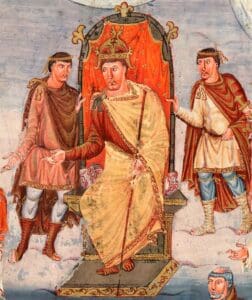 Admittedly, it wasn’t hard to portray Charles the Bald this way. Anyone who follows Viking history will know that he regularly paid Vikings to leave his kingdom or attack his brothers’ kingdoms, but they did the same as well. There’s nothing quite like brotherly love, isn’t there? Charles the Bald famously paid Ragnar Lodbrok 7,000 French livres (about 2,570 kg in gold and silver) to leave Paris in 845, which unfortunately for him started the trend of Viking leaders demanding ransoms for them to leave.
But what is the truth? Was he really a coward or just a young king out of his depth? We will never really know the truth, but looking at his life and his reign, you might say that perhaps I was a bit harsh on the king of West Francia.
King Charles II, or Charles the Bald, was the youngest son of Emperor Louis the Pious and his second wife and was born in June 823. The problems for King Charles started not long after his birth. His two older brothers were already adults when he was born and their father, Emperor Louis, had already given them their own subkingdoms. In 829, when Louis the Pious tried to give Charles a subkingdom of his own, by taking land away from his brothers of course, they revolted against him and started the first of many civil wars, which lasted until 843 when Charles the Bald, Louis the German and Lothair I signed the treaty of Verdun. As part of the treaty, the empire of Louis the Pious, who died in 840, was split into three kingdoms, each to be ruled over by the three brothers.
Charles received West Francia and at the age of twenty, he became a king. Unfortunately for Charles though, his problems didn’t end there. While the war with his brothers might have ended, Charles was still locked in a conflict with another family member, his nephew Pepin II, over the throne of Aquitaine. Pepin claimed to be the king of Aquitaine and was supported by the nobles, even though Emperor Louis the Pious had made Charles the king after he had fallen out with Pepin’s father and previous king of Aquitaine, Pepin I. It was during this conflict that Ragnar sailed up the Seine River with a fleet of 200 ships and plundered his way upriver until he reached Paris. King Charles attempted to stop him by assembling an army, but he made the mistake of splitting his army in two and posting them on either side of the river Seine. If you’ve watched the Viking TV Series, you’ll be aware of what happened next. Ragnar targeted the smaller half of the army and killed them all in sight of Charles and the rest of his army who stood helplessly by as they could not cross the river to help. After this defeat, King Charles marched the remainder of his army to the Abbey of St Denis, which he was fond of and wanted to protect more than the city of Paris it seemed, and allowed Ragnar to take the city without much of a fight.
Pepin II was finally captured in 852 and was imprisoned in a monastery near Paris. He would later escape (in 854) and continue his battle against King Charles and in 864, he joined forces with Danish raiders and attempted to take the city of Toulouse where he was captured again and executed. For Charles though, the imprisonment of Pepin in 852 did not stop his problems as the nobles of Aquitaine refused to accept him as their king and sent word to Louis the German, asking for his aid against King Charles. Louis the German sent his son, also named Louis, with an army to take Aquitaine and it was only the escape of Pepin II which prevented Aquitaine from falling into the hands of Charles’s older brother. The king of East Francia would try again to capture Aquitaine in 858 as he led an army into West Francia. King Charles who was unpopular with his people at the time could not raise an army to stop and was forced to flee to Burgundy. Again, Charles was saved by others as the bishops refused to crown King Louis and with a mutiny brewing in his army, was forced to return to East Francia empty-handed. The two brothers signed a treaty in 870 where they promised not to attack each other’s kingdoms again.
But it wasn’t all doom and gloom for King Charles the Bald. As part of the treaty he signed with Louis the German in 870, he added Lorriane to his kingdom. He also managed to get a firm grip on Aquitaine in 864 after the death of Pepin II and in 875, he became the Emperor of the Holy Roman Empire, a role he held until he died in 877.
King Charles was not a great military leader as most of his campaigns as king and emperor ended in defeat and his reign is often viewed as one of instability, but was it right of me to refer to him as a coward? Perhaps not, but it suited my story to do so.
On a side note, despite the moniker, Charles the Bald was not bald at all but was supposedly quite a hairy man. Something for you to think about.