
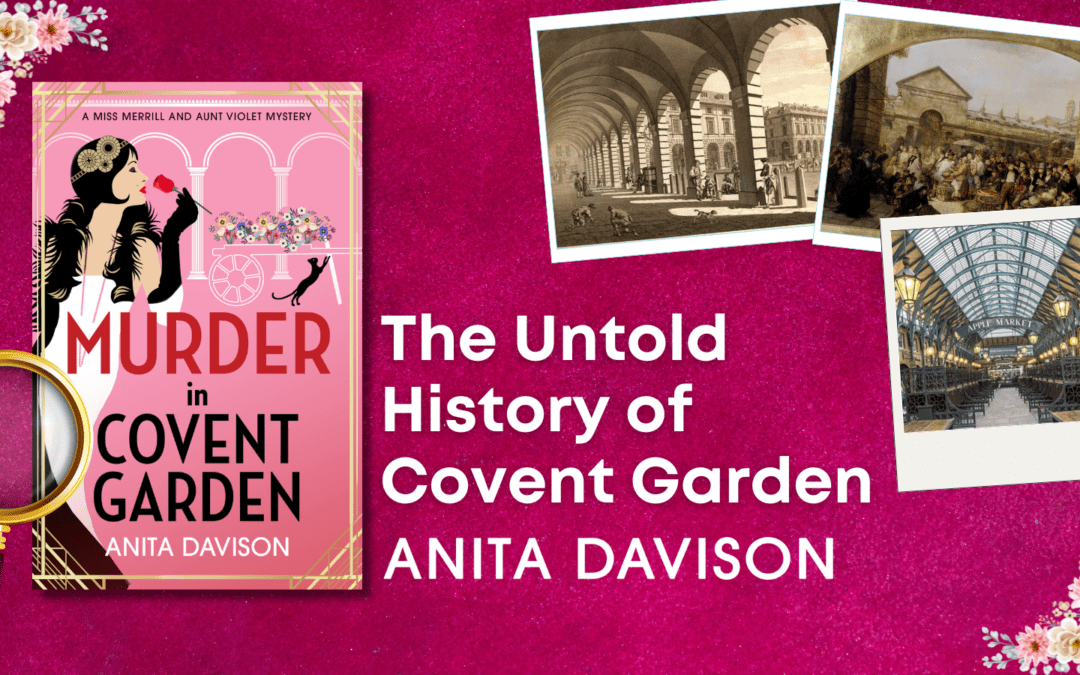
In the early 17th Century, the mixed orchard, meadow, pasture and arable land referred to as “the Convent Garden” was owned by the Benedictine monks of the Abbey of St Peter, Westminster lying between modern-day St Martin’s Lane, Drury Lane, and Floral Street and Maiden Lane.
Excavations revealed an Anglo-Saxon settlement of around 600 AD, stretching from Trafalgar Square to Aldwych, with Covent Garden at the centre. At around 886 AD, Alfred the Great gradually shifted the settlement into the old Roman town of Londinium and the site returned to fields.
In 2006 at St Martin-in-the-Fields revealed a group of late Roman graves, suggesting the site had been sacred since at least 350 AD.
Following the Dissolution of the Monasteries the lands reverted to the crown and in 1552 the young King Edward VI granted the land to John Russell, 1st Earl of Bedford, (c.1485–1555) the trusted adviser to King Henry VIII.
In 1630 Inigo Jones, with the support of Charles I was commissioned to create a public square at Covent Garden where he designed an Italianate arcaded square and a small ‘Tuscan’ style church of St Paul’s.
By 1654 the Italian style Piazza was barely completed when a small open-air fruit-and-vegetable market developed on the south side of the square, their wooden stands spoiling the clean lines and marble floors. Gradually, both the market and the surrounding area fell into disrepute, as taverns, theatres, coffee houses and brothels opened up.
After the plague [1665] and Great Fire of London [1666], people migrated to the West End and Covent Garden became a desirable address. By 1667, the commissioners for highways and sewers had to address the problem of the “great ffylth” generated by the traders of the market.
In May 1670, the 5th Earl of Bedford was granted letters patent to formalise the market granted by King Charles II. Only fruit, flowers, roots and herbs could be sold and the market could not extend beyond the Piazza. By this time the first pineapples began to be grown in England and adopted as the symbol of Covent Garden Market.
In 1748, a group of local residents petitioned against the noise, stench, obstructed streets, unauthorised selling of alcohol and the “great number of profligate and disorderly people who frequent the square in Irish Row”.
The Duke of Bedford had the market rebuilt, adding in an upper storey of shops and to entertain the 18th-century gentry, two theatres were built, The Theatre Royal on Drury Lane licensed by King Charles II and opened in 1662 where he had secret liaisons with his mistress Nel Gwynn, who had begun by selling oranges in the theatre before becoming a successful actress. The second was Royal Opera on Bow Street – both of which are reputedly haunted.
However, the gentry moved towards the more fashionable areas been built in Soho and St James as Covent Garden became a notorious red-light district, notably prostitutes such as Betty Careless and Jane Douglas. Jack Harris, the self-proclaimed ‘pimp general of all England’ would promote his business in the ‘Harris’s list of Covent Garden Ladies’, published annually from 1757 to 1795 and sold for the princely sum of two shillings and sixpence.
In 1828, Whig politician John Russell, 6th Duke of Bedford, flush with money from the sale of land near The Strand, petitioned the government to improve and regulate the market, knock down the Piazza’s ramshackle stalls, erect a proper market building and institute a regulated system of rents. Designed by Charles Fowler in a neoclassical style granite pillars and four corner pavilions. The building had large north and south halls separated by a central avenue. The market opened in May 1830, the cast iron glass roof added in 1875. The market grew and further buildings were added: the Floral Hall, Charter Market, and in 1904 the Jubilee Market.
Covent Garden Trivia
• Long Acre in Covent Garden is named after the acre strip of market garden that was once owned by the monks of Westminster Abbey.
• The lamps in the Market Building are shaped liked pineapples and this is because Covent Garden was the first place you could buy the fruit when it was first brought to England.
• Drury Lane Theatre is haunted by the “Man in Grey” an 18th-century nobleman who was stabbed to death in the theatre, his skeletal remains having been found in a walled-up passage in 1848. He wears a cape, a tricorne hat, riding boots, and a sword and is often seen in the upper circle moving along the rear gangway near the royal box where the remains were discovered.
• Covent Garden has over 60 pubs and bars – The area’s oldest, The Lamb and Flag was famous for fierce bare-knuckle prize fights in the early 19th century that it earned it the nickname “Bucket of Blood”.
• The journey from Covent Garden Tube station to Leicester Square on the Piccadilly line is the shortest trip on the whole London Underground network, covering 260 metres and taking only about 20 seconds.
• The first Punch and Judy puppet show was performed in the portico of St Paule’s Church Covent Garden in 1662, as documented in the diaries of Samuel Pepys.
• The Theatre Royal on Drury Lane is rumoured to have an underground tunnel so the actors could swiftly get to the nearby pub.
• John Montagu, the Earl of Sandwich, first ordered a slab of meat between two pieces of bread in 1762, at the Beef Steak Club at the Shakespeare’s Head Pub on Wych Street, off Drury Lane – invented to keep the Earl’s fingers and playing cards clean from grease while he was gambling.
“Thames Street gives cheeses, Covent Garden fruits;
Moorfields old books, and Monmouth Street old suits.”—Gay’s Trivia.
John Gay, Trivia: or the Art of Walking the Streets of London gives a fascinating picture of 18th Century Covent Garden
https://www.amazon.co.uk/Walking-Streets-Eighteenth-Century-London-Trivia/dp/019928072X