
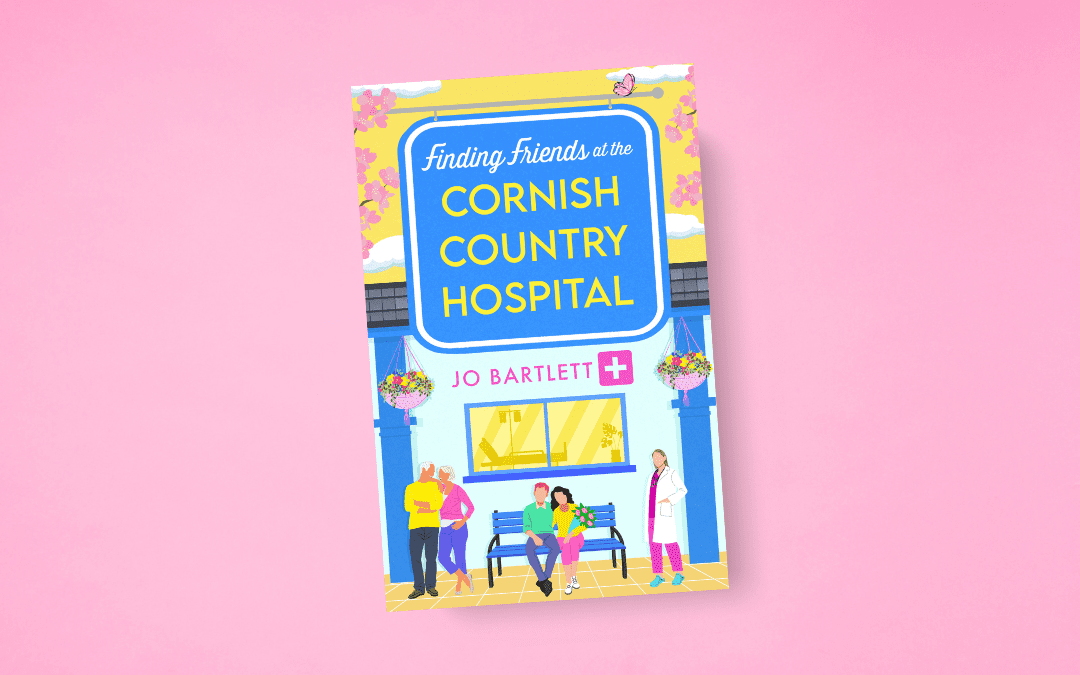
Today is publication day for Finding Friends at the Cornish Country Hospital. This story features Esther, who is recovering from the heartbreak of a broken engagement, and her mother, Caroline, whose own life seems to be unravelling too. Caroline has always felt blessed, with her beloved daughter, and her husband, Patrick, who has always been her best friend.
Except suddenly everything is changing. Caroline appears to have become invisible, even to Patrick, she’s lost her confidence and barely knows who she is anymore. Menopause feels as if it has robbed Caroline of everything she was. The physical symptoms are bad enough, but worse than that is the brain fog, which begins to make her fear she’s suffering from dementia, and the crippling anxiety that leaves Caroline longing to hide away.
That might all sound extreme, and perhaps even an over-dramatisation of what going through menopause feels like for many women, but I know from the research I have undertaken, that what Caroline is experiencing is only too common.
I’ve chatted with friends about their experiences, as well as with my readers, and below are some anonymous insights that they’ve been generous enough to share with me.
‘Since starting perimenopause, I’ve felt an irrational anger I’ve never experienced before and it scares me how little control I feel I have sometimes. My anxiety is through the roof and I hate the person I’ve become, a hermit who never wants to go out.’
‘I’ve become paranoid, constantly accusing my husband of fancying other women. I think it’s because no one seems to notice me anymore, now that I’ve lost all my spark. I used to get flirted with a lot, but that’s completely stopped and it bothers me more than I ever thought it would’.
‘For me, it’s the physical symptoms. I’m always itchy and everything seems to ache. Every time I look in the mirror I can see more of my scalp and I’m terrified I’m going to go bald. I’ve even got acne, and it’s ten times worse than in my teens.’
‘I’m on the highest dose of HRT available and I still feel capable of murder most days! God knows what I’d be like without the HRT and I’m really scared of how I’m going to feel if the GP ever takes me off it.’
‘The insomnia is unbearable, and I’d do anything to be able to get a good night’s sleep again. The worst thing about being awake when everyone else is sleeping is that the anxiety gets control of me and I can really start to spiral.’
‘Menopause quite simply makes me feel like I’m not me anymore and slightly losing the plot, well maybe I am! Cannot take HRT, so just left to my own devices winging it with supplements. God know if they’re doing any good, but if I feel like this with them God knows what I would be like without them! I get a ‘day of doom’ regularly, gone the next day, but wake up under a black cloud. I wish menopause would just do one!’
Caroline’s experiences mirror those of so many of the women I have spoken to, and it felt really important for me to depict this stage of life in the book, as well as the impact menopause has on her. It’s a subject I’m sure I’ll come back to and, if you are going through a difficult time at the moment, and you’re in need of support, don’t let anyone tell you it’s ‘just menopause’ or that you need to ‘get on with it’. Instead, reach out to your GP, or to one of the wonderful online sources of support, like the at the link below:
https://www.themenopausecharity.org/menopause/
It’s not all doom and gloom, and something I guarantee in my feel-good series is that the characters will find their way to a happy ending, whatever that looks like. In real life, there are also millions of women who’ve gone through menopause and discovered that this often very difficult phase of life is by no means the end. Laura Wilder, author of The Little House on the Prairie, didn’t publish her first book until the age of sixty-four, Dr Carolyn Westhoof. who in her mid-sixties is leading the transformation of women’s reproductive health, Kimberlé Crenshaw, a renowned civil rights activist in her late fifties, and recent Oscar winners, Frances McDormand, sixty-three, and Youn Yuh-Jung, seventy-three, are just a handful of examples that prove it’s never too late for women to achieve great things.
Take care, look after yourselves and, if life is tough at the moment, may better days be ahead.