
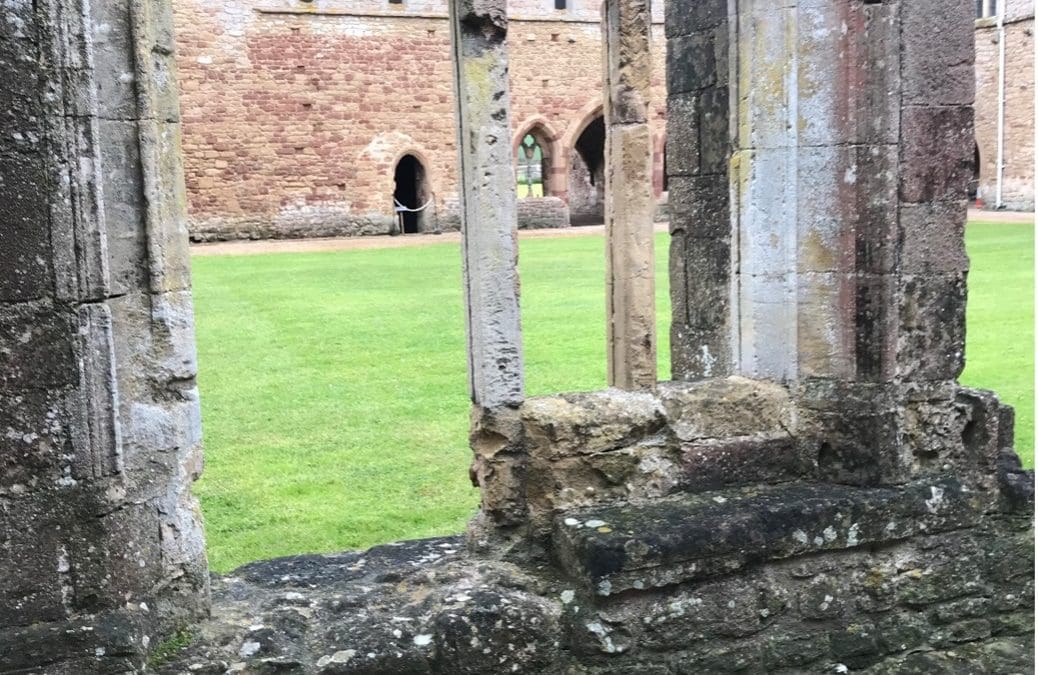
Cleeve Abbey and Henry VIII
At historic Cleeve Abbey you can mount the ancient stairs into the monk’s dormitory, stand on the site where the monks’ latrine was situated, and enjoy the calm of the central cloister.
Libby Forest and the members of the Exham on Sea History Society saw these sights and more when they visited Cleeve Abbey in the heart of Somerset for their annual picnic.
They found the abbey better preserved than many of the country’s monasteries. Small and intimate, it still wore an air of calm contemplation from the years of silence enjoyed by the monks of the Cistercian order.
Fascinated, Libby and her new husband Max set about researching the abbey’s history, and Henry VIII’s Dissolution of the Monasteries which destroyed it forever.
This is what they discovered…
Henry VIII’s dissolution, sometimes known as the suppression of the monasteries, was set in train by Henry’s need for a son and heir. Happily married for almost twenty four years to the Spanish Princess, Catherine of Aragon, (sometimes spelled Katherine) Henry saw that after a succession of still births and miscarriages she was never going to give him a living male heir.
They had a daughter, Mary, but she was a girl and therefore could not rule. Or so they thought – in fact, she later became Queen and was closely followed by her sister, Elizabeth. As Libby would say, ‘Take that, Henry VIII.’
Henry began looking for excuses to try another wife for size. He’d met Anne Boleyn and thought she might fit the bill – and as she reputedly refused to let him near her without a wedding ring, marriage to her became his goal.
Scouring the scriptures, Henry’s courtiers thought they’d found a loophole; Catherine had been married as a teenager to Henry’s older brother, Arthur. Arthur died before his father, Henry VII, so he was never crowned king. According to the Bible’s Old Testament, Henry’s side argued, Henry could not legally marry his brother’s widow. Henry stuck to this assertion, even though he’d already asked the Pope about it and the Pope had no objection to his union with Catherine.
Everything hinged on whether or not Arthur and Catherine had consummated their marriage. They were both very young at the time and in later life Catherine insisted they had not and she was still a virgin. However, her word was not good enough for Henry.
We don’t know the facts, but Henry decided it would fit his ambition best to announce that the marriage with Catherine was ‘adulterous.’ That gave him an excuse to put her aside.
The Pope was horrified and threatened Henry with excommunication from the Catholic Church.
Henry then went further and announced that the Pope was not Head of the Church in England, anyway, so he didn’t care for his opinion and he would marry Anne Boleyn. This, as we all know, did not end well for Anne.
At least Catherine managed to keep her head.
As Henry was now Head of the Church in England, the enormous wealth owned by the monks belonged to him. He was, at it happened, short of a bob or two at the time, so he decreed the smallest monasteries should be dissolved.
That’s where Cleeve Abbey came in.
There were just thirteen monks in the Abbey, giving most of their money to the poor and needy, and not costing Henry anything. In fact, the Cleeve Abbey monks were generally a good bunch. Nevertheless, along with the other smaller monasteries, Cleeve Abbey was dissolved.
Several of the monks moved to other, larger monasteries which were spared for a time – although not for long. Henry soon found he needed even more money. The rest of the Christian world, as well as the Pope, was angry with him and he faced the possibility of invasion, especially from France. So the other English monasteries; bigger, richer ones, followed Cleeve Abbey into oblivion.
After this, England’s attitude to religion oscillated wildly. Henry’s death led to his short-lived son Edward’s short reign that resolved nothing. Then Henry’s daughter, Mary Tudor, turned back into the arms of the Pope and Catholicism.
Elizabeth I, Henry’s daughter with Anne Boleyn became the next monarch and managed to calm religious matters during her long and internally peaceful reign, stating that she had no intention of looking ‘into men’s hearts’ and avoiding the issue.
But the monasteries were gone for good, sold to the highest bidders.
In such a time of turmoil, who can know exactly what happened to all the monks in the eye of the storm? Some Cleeve monks moved to other monasteries, but the fates of five of them are unknown.
Rumour has it their monkish spirits still walk the peaceful stairs and grassy cloister of Cleeve Abbey.
Could that be true?
Libby, Max and their Exham on Sea friends were keen to find out, and so they spent the night at the abbey, watching for ghosts, and you can follow their story in Murder at the Abbey, the eighth in the Exham on Sea Murder Mystery series.
Order your copy: