
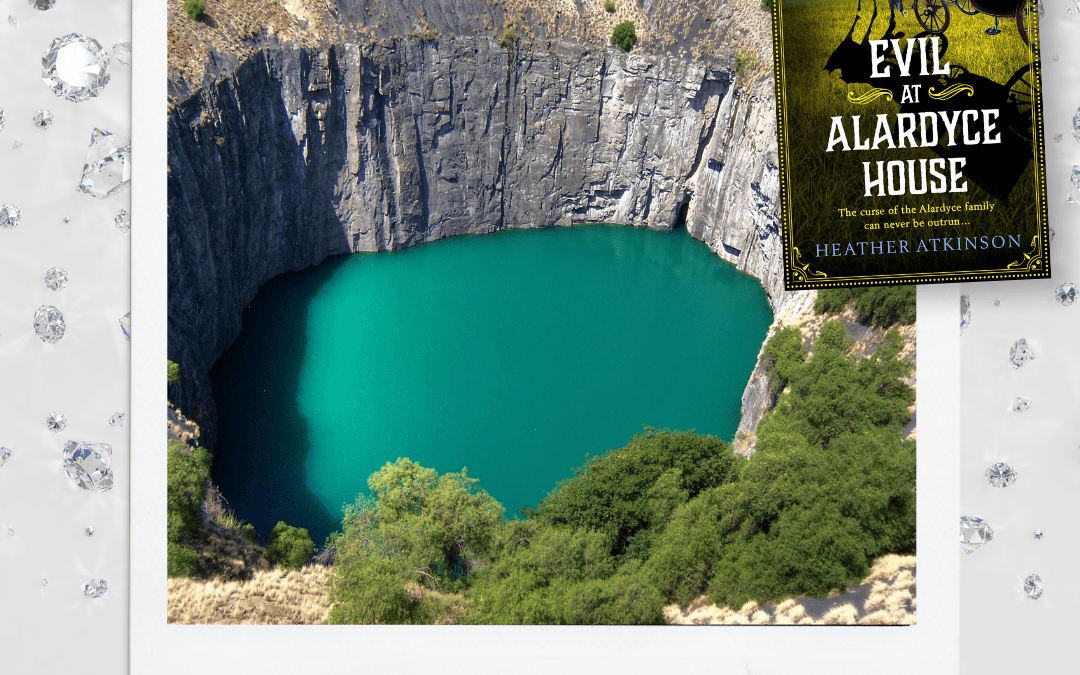
Diamond mining features prominently in Evil at Alardyce House and my research into it was very interesting. In the book, it takes place in Kimberley, South Africa. The story of diamond mining in South Africa was started by a fifteen year old boy called Erasmus Jacobs who lived on his father’s farm beside the Orange River near Hopetown. In 1867, the boy found a clear rock. This rock was to become one of the most famous diamonds in the world – the Eureka Diamond. It can still be seen in the mine museum in Kimberley and belongs to the People of South Africa after it was donated by the De Beers Company.
Kimberley is now the capital city of the Northern Cape of South Africa with a population of over 225,000 and is most famous for its Big Hole, a massive, open pit a mile across, excavated by hand. It was once the richest diamond mine in the world and the Big Hole along with the other three Kimberley mines were producing 95% of the world’s diamonds by the 1870’s. It was also responsible for the rise of the famous De Beers Company. Today, the Big Hole is a shadow of its former self and has been turned into a tourist attraction. In 1888, when Evil at Alardyce House is set, the Big Hole was a hot and very dangerous hive of activity responsible for a large number of accidents and deaths. Due to the massive number of people migrating into the area to try and make their fortune, Kimberley quickly became a very large and sophisticated city. The people were proud of what they had achieved and wanted to show off their wealth and success, creating a cosmopolitan town with all the mod cons of the age.
Of course, such a place generated fierce rivalries, mainly between Barney Barnato and Cecil John Rhodes, both British immigrants. Characters very loosely based on these two men appear in Evil at Alardyce House but all the various buildings mentioned in the book are real and existed at the time. Barnato was the one who came up with the idea of controlling the supply of diamonds to force prices up or down. Both men came up with various schemes to gain the majority control of diamond mining in the area, but when these plots failed, they realised that partnering up would be the sensible option and the De Beers Company was born.
The Kimberley mines were forced to close for 124 days in 1899 when the town was besieged during the Second Boer War but reopened again. However, the First World War was to prove the Big Hole’s death knell and it was permanently closed after 43 years of operation. However, the remaining three Kimberley mines continued to operate until 2005, when they too were closed, marking the end of some fascinating but controversial history. Kimberley is known as the diamond capital of the world and is still a centre for mining and cutting diamonds.
Start reading Heather’s latest book here: https://mybook.to/Evilalardycesocial