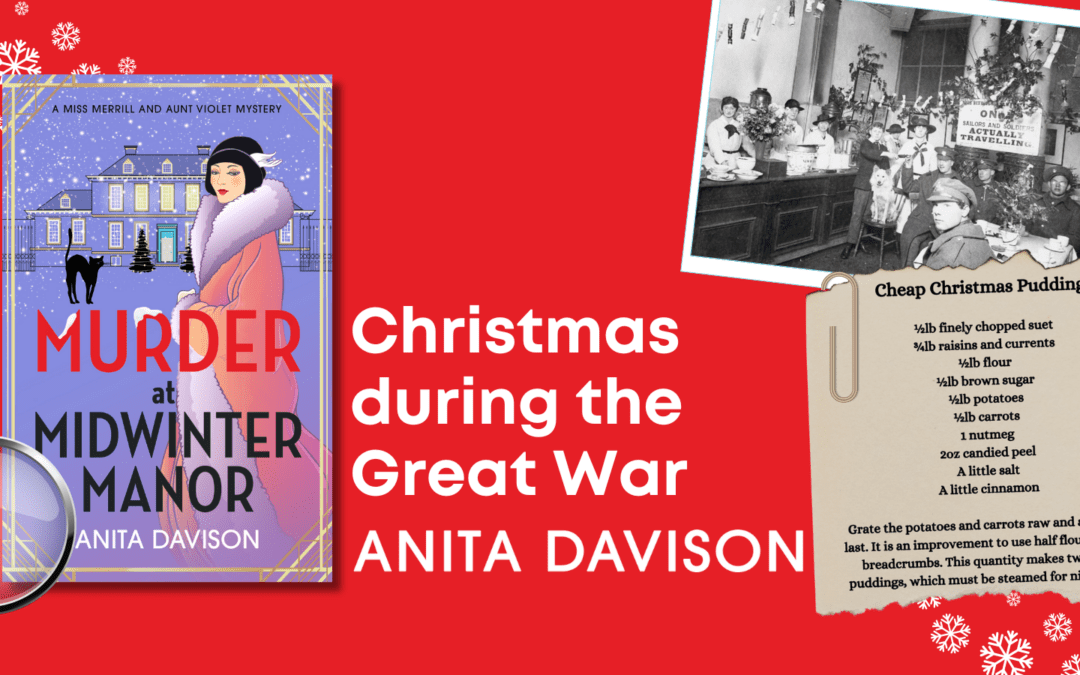
Anita Davison’s new novel Murder at Midwinter Manor is a historical mystery set over Christmas during the Great War and is out now! Click here to read it!
As a third-generation Londoner, writing the Miss Merrill and Aunt Violet mysteries, I often wondered what it must have been like for my family living in the city during the Great War. My Great Grandparents were German but granted British Naturalisation helped by the fact that all their twelve children were born in London and five of their sons were serving in the British Army between 1914 and 1918.
For Hannah and her Aunt Violet, the Christmas of 1916 promises to be a relatively comfortable break from London spent at the county home of Hannah’s sister, Iris and brother-in-law, Mycroft Atherton. The guests have brought all the food they can source with them and petrol is still available, if doubled in price from 1914.
For those in London, that winter was a hard, cold one, the struggle to keep everyone warm and fed was exacerbated by having so many young men taken out of the workforce and sent to the Front Line. Even so, the shops were still busy that December although enthusiasm for the festive season was subdued as the country faced their third Christmas at war with no end in sight.
Following appeals in the papers for something to be done to greet those soldiers arriving in London on leave, groups of ladies volunteered to run free buffets at the main station terminals. The first was set up at London Bridge in late 1914, followed in early 1915 by Victoria and Liverpool Street until buffets were set up at all major train stations.
These buffets supplied a hot drink and a meal to soldiers and sailors on arrival in London or who waited for their train back to the front. The London Ambulance Column volunteers who met trains of wounded were also included as they often spent whole days or nights in the station or on the road.
The buffet at Waterloo, located in the pedestrian tunnel under the platforms, served eight million service personnel, and at Victoria served 12 million by the time they closed in 1920.
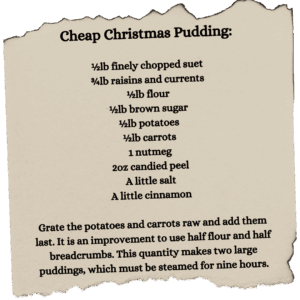
Food as always was a main feature of the season at home, but had to be adapted to accommodate the food shortages. The recipes below were printed in The Bystander Magazine on December 20th 1916.