
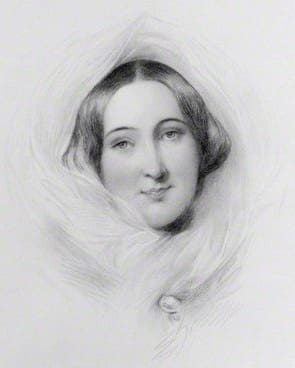
Rosina Bulwer Lytton
Rosina was born in 1802, the daughter of a women’s rights advocate and an Anglo-Irish landowner.
In 1827 she married Edward Bulwer-Lytton, a novelist and politician. His mother did not approve of the marriage and withdrew his allowance which meant he had to earn his own living.
Perhaps Edward blamed Rosina for this inconvenience, or perhaps there were other reasons, but their marriage failed and the couple legally separated in 1836. Rosina’s two children, Emily and Edward, were taken from her. Three years later her novel ‘Cheveley’, or ‘The Man of Honour’ was published. Her husband was bitterly caricatured within its pages.
In June 1858, Edward was standing in a by-election as a parliamentary candidate when Rosina appeared at the hustings and denounced him for his treatment of her. He accused her of insanity, and she was detained in a private asylum for the mentally defective. There followed a public outcry and she was eventually released.
Rosina was fortunate in that the imprisonment of ‘difficult’ women at the behest of their male relatives was a popular topic at the time. The issue had been brought to public attention with the publication of the Wilkie Collins’ novel The Woman in White, based on the true case of Louisa Nottidge.
Rosina wrote about her experience of being found insane in ‘A Blighted Life’, published in 1880. She was scornful about her husband and his associates and exposed the role of medical professionals in the detention of sane individuals in Victorian asylums. Unfortunately, she was often vilified for being an ‘hysteric’ who misrepresented an eminent man.
Hannah Mackenzie
In 1766, Peter Mackenzie was having an adulterous affair with his wife Hannah’s niece.
Peter was keen to install the niece as mistress of the household, which meant removing Hannah from the position. He invited a prominent ‘mad-doctor’, Dr Battie to the family home to confirm his suspicions that Hannah was insane.
Realising she was at risk, Hannah fled, but she was tricked into returning, locked in her bedchamber and restrained in a straitjacket.
After that, she was taken to Peter Day’s Paddington madhouse – a private lunatic asylum.
The resourceful Hannah managed to attract the attention of a boy working in the garden of the house next door from an upstairs window. She was eventually rescued from the asylum, with the help of John Sherratt, a lawyer and well-known campaigner against private madhouses.
The Room in the Attic is out now!

