
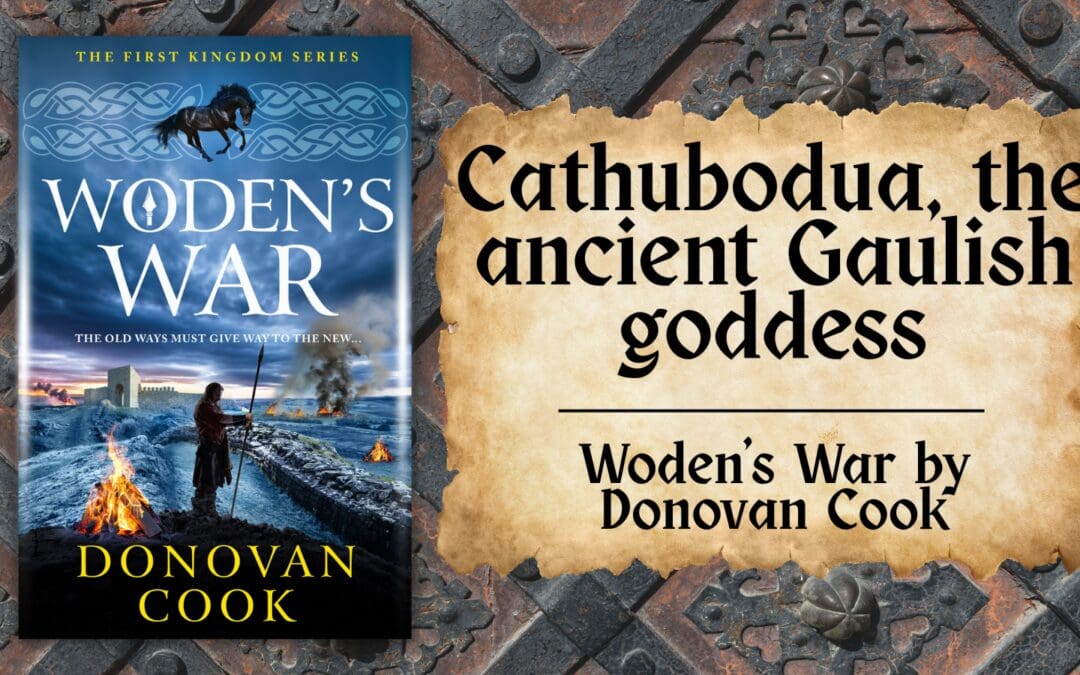
One of the many challenges of writing The First Kingdom Series, set in fifth-century Britain, is understanding what people believed before Christianity became the dominant religion. The main reason is that there is little, or at times no, written evidence of the gods who once ruled the misty hills of Britannia. Sometimes the only evidence of a deity is a single name carved into the stone of some long-forgotten monument.
And in this series, I introduce one of those gods: Cathubodua.
While researching the Celtic beliefs that I wanted to introduce intoThe First Kingdom Series, I came across this obscure goddess who immediately caught my attention. She appears to have been a Gaulish goddess associated with warfare, although, as with many Celtic gods, little is known about her.
Much of the evidence comes from a Roman-period inscription discovered at Mieussy in modern-day eastern France. It reads Athubodua because the beginning of the name is damaged, though scholars have long suggested that the missing letter may have been a C, giving us the name Cathubodua.
Her name is particularly intriguing. The first element, catu or cath, is associated with battle, while the second has been linked to the Irish Badb, a supernatural figure strongly associated with warfare and birds such as crows. This has led Cathubodua to sometimes be interpreted as something close to a battle-crow goddess.
Later Irish traditions speak of war goddesses appearing in bird form and haunting battlefields, though we don’t know for certain whether Cathubodua was believed to do the same, as tempting as that interpretation may be. Another thing that struck me was the similarity between these Irish war goddesses and the Valkyries of Norse mythology, supernatural women who were also closely associated with battle, death and the fate of warriors.
And that uncertainty is actually part of what makes Cathubodua so interesting to me as a writer.
With Woden and his famous spear, Gungnir, I am working with mythology that has left us considerably more material. Cathubodua gives me something different: fragments that we can build upon without losing sight of how little we genuinely know.
She also fits naturally into the world of The First Kingdom. These were violent times. Kingdoms were fought over, old alliances collapsed and new nations were forged through blood and fire, while men such as Octa and Badulf increasingly found themselves surrounded by death.
What better presence to begin emerging from that world than a goddess connected with battle itself?
Cathubodua plays a key role in Woden’s War and in Badulf’s actions, but she will not be confined to this book. As the series continues, I want to explore more of the beliefs of the people of Britain and how those beliefs collided with the gods brought across the sea by the Saxons and Jutes, as well as how the old religions faced the ever-growing influence of Christianity.
And Cathubodua may have a larger part to play in that conflict than anyone yet realises.
I hope you enjoy reading about Octa’s next adventure in Woden’s War, as he finds himself deep in the midst of a battle he still doesn’t fully understand.