
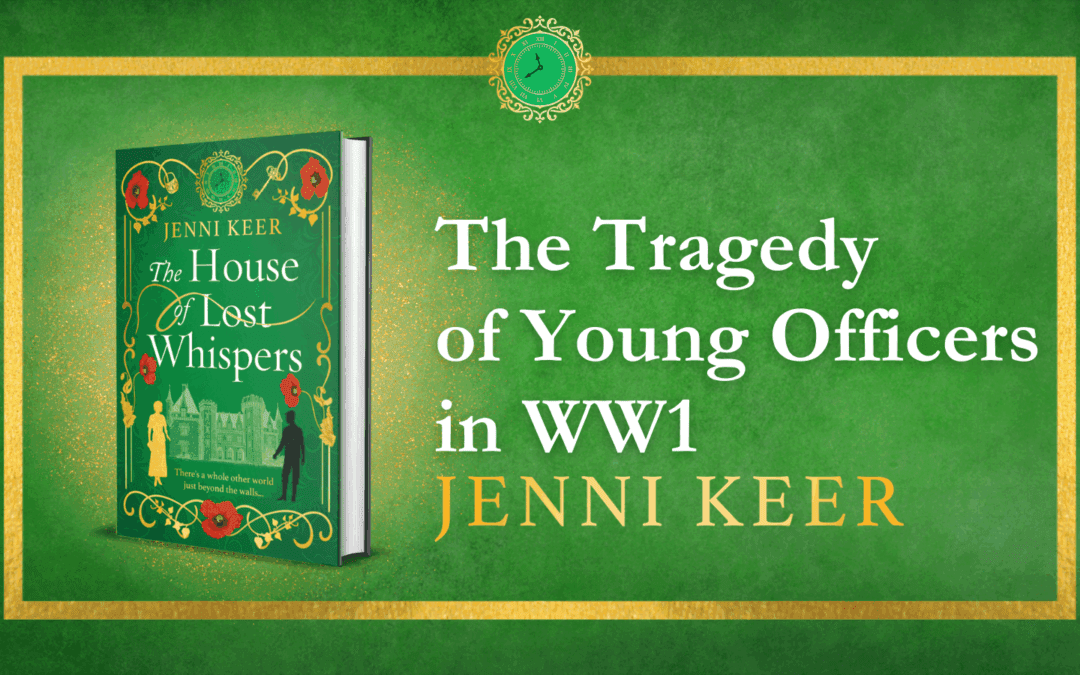
Part of my latest novel, The House of Lost Whispers, follows the fictional Fairchild family who, in 1914, have four sons, three of whom will ultimately be involved in WW1. As a mother of four young men currently aged between 20 and 23 (yes, there’s a set of twins in there!) I found this research particularly poignant. The Fairchild boys are privileged. They’ve all attended private school and the oldest two are studying at Cambridge. Because of the growing threat of an imperialist Germany in the early 1900s, these schools and universities ran Officer Training Corps, hoping to address the shortage of trained officers in the military.
The book “Six Weeks” by John Lewis Stempel, highlights the brutal reality that this was the average life expectancy of these subalterns. Easily picked out by snipers because of their uniform (although this was realised as the war progressed) and often leading their men into battle, a disproportionate number of upper-class young men died in the conflict. Even more heartbreaking when you realise most went straight from the schoolroom to the battlefield.
So, I feel for Lady Fairchild as she watches her boys head off to war, one by one, not knowing if she’ll ever see them again, especially as, if they died “for King and Country”, they would be buried abroad. And those who survived, came back irrevocably altered – mentally and physically – suffering injuries on a scale never witnessed before: lost limbs, disfiguring scars and “war neuroses” (or PTSD) that society struggled to deal with adequately.
Although my story looks at the war from Olivia’s point of view, I hope that I have done the horrific experiences of Clarence, Louis and Howard Fairchild justice, but it was incredibly emotional to write knowing that, had my family been around over a century ago, all my sons would have been conscripted by 1916.
Jenni x