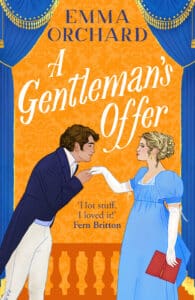
Emma Orchard is the author of authentic and spicy regency romance, including A Gentleman’s Offer, out now! Click to read 📖
One of the most enjoyable things, for me, about writing Regency romance is the dialogue. It’s so incredible rich and flexible, and conveys such a lot. A character can easily use several different registers in the same chapter – my hero will speak in one way to his friends, another to his servants, and yet another to the heroine. Women and men employ different words; British English isn’t like that any more, though other languages are. There are strict rules and social conventions governing vocabulary, and who can say what to whom, but the great thing about rules is the pleasure to be had in breaking them. And they can be surprisingly useful in advancing the plot. In one of my novels, the heroine reveals that she’s involved in a scandalous relationship with the hero just by using his first name carelessly, even though what she actually says is completely innocent.
The most distinctive language in novels set in the period is slang, or cant. It’s the sound of the streets, used by criminals in particular but young, reckless men as well, and it’s enormous fun to make use of. I came across it first in Georgette Heyer, and I only later realised that her source for a lot of her vocabulary was an amazing book called Grose’s Dictionary of the Vulgar Tongue, first published in 1785 and hugely popular for many years afterwards. If you want to know the many phrases you’d use to describe being drunk in Georgian England, this is the book for you. You might be bosky, foxed, disguised – you might even have shot the cat, in which case, poor you, you’ve probably been sick, or cast up your accounts, though I don’t know how the cat comes into it. You might have sucked the monkey (I swear I’m not making this up). You might even be a vice-admiral of the narrow seas – you’re going to have to research that one yourselves, but let’s just say it wouldn’t make you popular, and yet, alarmingly, it must have happened often enough that there was a phrase for it. Personally, I’ve never been that drunk, and I hope never to be.
There are endlessly inventive ways to describe people’s characters, their jobs and their appearances. You might be gooseberry-eyed, or bran-faced; you might be a jack of legs or a long meg. A doctor could be described as a piss prophet, presumably because they attempted to diagnose people by looking at their urine, and a teacher as a bum-brusher because of the frequency with which they beat their pupils (or at least I hope that’s why).
I should probably warn you that some of the phrases are deeply offensive, as you might expect, and many of them are downright filthy – it’s not described as the vulgar tongue for nothing. Rather frustratingly, Grose likes to titillate his readers by refusing to give definitions for some of his dirtiest words, preferring to leave it to our wildest imaginations. If anyone reading this actually knows what “larking” meant, I’ll happily send them a free signed book. If Heyer knew, she wasn’t telling. And the very fact that she must have read this book (I wonder if she owned it?) sheds a new light on her – perhaps she wasn’t as demure as we like to think.
One of the fascinating things about cant is that some of the words – for instance a few of the words for sex – are still in use, though most of them have faded into obscurity and are only used now in novels like mine. Words may change, but people don’t. Groups, especially marginalised groups, have always had their secret languages, and anyone who thinks that everyone in the past was incredibly prim and proper is very seriously mistaken, and is missing a lot. Grose doesn’t list the riper swear words – but that doesn’t mean people didn’t use them. There is nothing that gives me more pleasure than dropping a shocking word into dialogue when readers might least be expecting it. As you’ll find if you read A Gentleman’s Offer…
Get your copy of A Gentleman’s Offer now!