
Tuscany and Wine
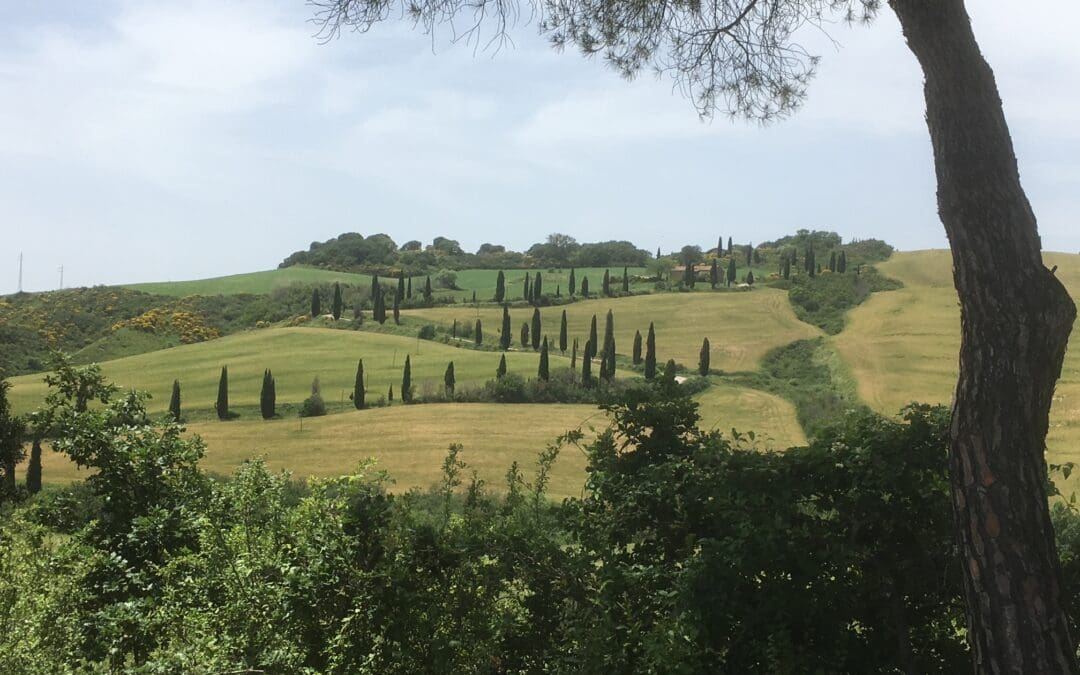
The latest in the Armstrong and Oscar cozy mystery series is called Murder in the Tuscan Hills. No prizes for guessing where it’s set, the clue’s in the name. Anybody who has visited or seen photos of Tuscany will be familiar with the wonderful rolling hills, carpeted in green, dotted with olive groves, the iconic Tuscan cypress trees and, of course, vineyards.
Wine isn’t just a major industry in Tuscany, it’s a way of life. Murder in the Tuscan Hills is set among the vineyards to the south of Florence in an area I know well, having lived there for a number of years. The first thing that always strikes me when I go back is the mathematical precision of the lines of vines. In the winter when the leaves have turned brown and fallen off, there are brown lines on the hillsides. When spring comes around, the whole scene takes on a series of different colours, ranging from the bright green of fresh leaves to the dusty dark green of the summer, and the rusty hue of autumn.
Like so many wine producing regions around the world, you will now find new varieties of grape being planted, but Tuscany is still predominantly a red wine area and the most famous of these wines is, of course, Chianti. Down in the south of the region there are some other fine wines including the famous Brunello di Montalcino. If you drive through the countryside, almost every farm advertises wine for sale, and that can be in bottles, but also in larger quantities. Many Italians buy wine in bulk – it is, after all, considered a staple, like bread or pasta – and the normal way of buying bulk wine is in a huge glass vessel set in a protective straw/wicker basket. This container is called a damigiana – according to my old dictionary, the English word for this is a demijohn, and they normally hold upwards of fifty litres of wine.
People buy wine in bulk and then bottle it themselves. I used to do this and rapidly made the unexpected discovery that wine on your hands when it dries, dries blue, rather than red. I believe it’s something to do with oxidisation, but don’t ask me. Bottles can then be corked or, more normally in Tuscany, people simply pour a small quantity of oenological oil onto the top. This clear, odourless oil forms a barrier against the air, and wine can be kept for many months.
But why would you want to keep it and not drink it?
I hope you enjoy this next trip to beautiful Tuscany.
Start reading Murder in the Tuscan Hills here: https://mybook.to/MurderTuscanHills