
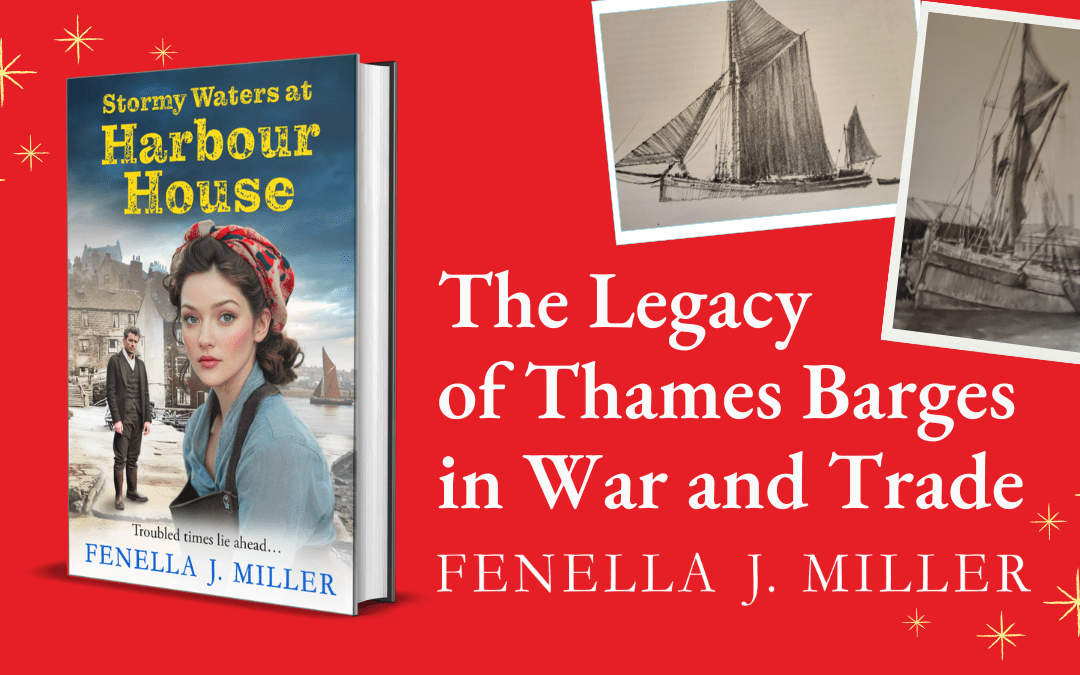
A Thames barge being flat bottomed could sail in rivers and shallow waters that bigger crafts couldn’t. They had no keel but lee boards which could be raised and lowered to give stability when out to sea. They had a vast quantity of rust red sails which when raised was a magnificent sight. You can still see them sailing up and down the river Colne past Wivenhoe in the summer at the regattas. It’s always a heart stopping moment to think that one of these actual barges could have sailed to Dunkirk to rescue stranded soldiers all those years ago
A barge could carry huge amounts of cargo – often grain, cement, bricks and so on, and didn’t require precious fuel as they were sailing vessels. They could work with a crew of two, but there was often a young man, little more than a boy, who would deal with the catering and so on.
The Thames barge skipper had to be an expert on the waters he sailed, they had nothing but a compass and their knowledge of the stars and the coast to guide them.
The captain had an excellent cabin, usually panelled with wood, a decent bunk and comfortable furniture. The mate would have the starboard bunk in the forecastle – that would be the senior side. There was a coal range for cooking and the kettle was always on – the third member of the crew if there was one, could lower his boot and push the kettle over the coals to boil when still on deck.
The bunks had two blankets, if they were lucky, but as they usually slept in their clothes there was no need for sheets.
The crew didn’t eat well when they were sailing but made up for it, if they had the funds, when they were moored. Fresh bread, pasties of any sort, sticky buns and quantities of tea were their main diet. It was very rare that any of them ate fish.
There was one skipper who used to buy fresh bread at every stop but wouldn’t eat the fresh until he’d eaten the old – he’d scratch the date that he bought the loaf on the crust. He would sometimes have ten loaves waiting and of course they’d all be stale by the time he got to them.
Sailing with no cargo was called sailing light – which no skipper wanted to do is it meant they wouldn’t be making any money. There were no lit buoys during the war – obviously because of the risk of attracting German bombers – the only aid to navigation was a compass, the lead line and the skipper’s knowledge.
All sailing vessels were under the direct control of the Admiralty during the war and every voyage in and out had to be recorded with a naval officer on shore. The skippers of the Thames barges were old school, they resented being ordered to do things by men half their age who didn’t have their knowledge of the sea. However, like all men during World War II, they did as they were asked and saved the moaning for the cabin at night.