
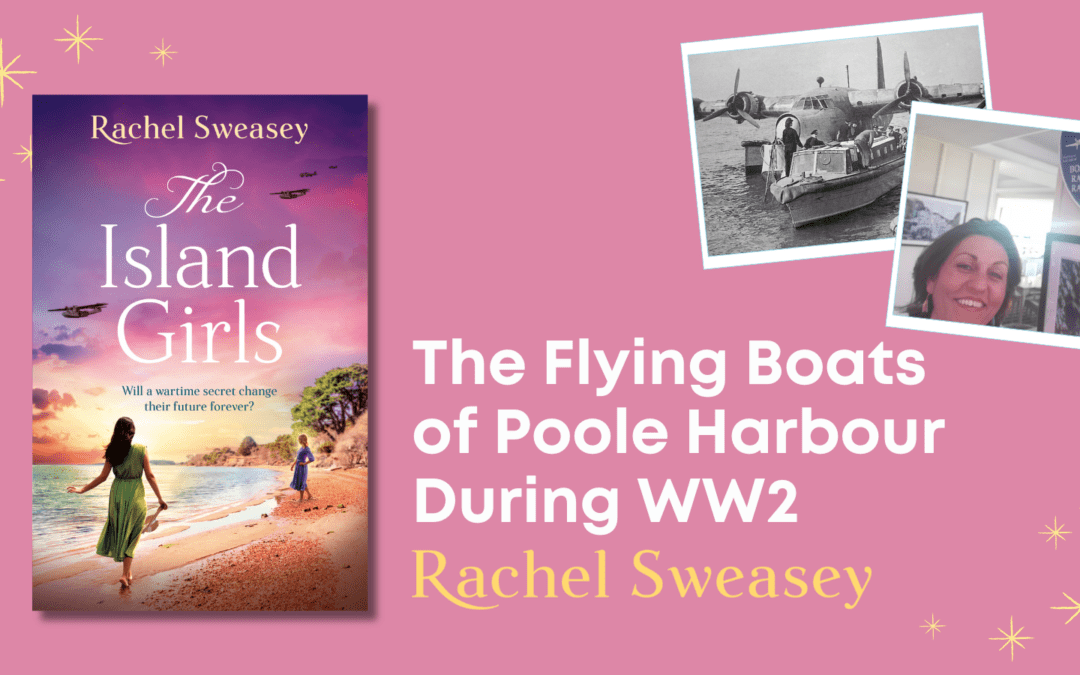
The Island Girls by Rachel Sweasey is out today! Click to get your copy 📖
le Harbour was a stunning playground to grow up in. As a child I was blessed to spend weekends and holidays with my family sailing around the harbour. We would sail to Brownsea Island, tying up to Pottery Pier and playing on the beach or paddling on the shore, looking for cockles. Sometimes we sailed across to Shell Bay, for a day of sunbathing and swimming without any of the hassle of parking, and then getting back into a hot car at the end of the day. In my memory, Poole Harbour was blessed by an eternal summer for endless salt-crusted adventures. An idyllic way to live, having begun life in the hot sun of Brisbane, Australia.
The harbour was – and still is – so shallow, that I always found it incredible a ship so large as the cross-channel ferry, Barfleur, could get safely from the dock near Poole Quay to the harbour’s entrance. There is one main channel that is repeatedly dredged for the purpose. For getting around the rest of the harbour, we had an amazing little sailing boat with a lifting keel, meaning we needed no more than paddling depth water to sail her.
But one kind of vessel I never imagined, or had even heard of when I was living my famous-five childhood, was a flying boat. World War Two, Poole Harbour became the only international airport for the British Overseas Airways Corporation, with dozens of flying boats moored up and taking off from the ‘runways’ marked out with buoys. These big-bellied luxurious flying boats would travel from Poole all over the world, even as far as Sydney, Australia. I only learned about them when I was researching for my first book, The Last Boat Home, and discovered that Poole Pottery had become the Customs and Immigration base for passengers flying overseas.
There is now an amazing trail of this history around Poole in the form of blue plaques and a fabulously informative website, The Poole Flying Boats Celebration.
But it wasn’t just B.O.A.C. (which went on to become British Airways) that was operating flying boats in the harbour. There was also an RAF base, at Hamworthy where the Royal Marines base is now, where a Royal Australian Air Force squadron was based, flying patrols over Europe and the Atlantic. These Short Sunderlands are credited with destroying a total of six German U-boats, as well as taking part in valuable search and rescue missions.
With my love for Poole Harbour and beautiful Brownsea Island, my own ties to Australia and the discovery that some Aussie airmen made such an impact in Poole, the flying boats sparked the story idea for The Island Girls, and I think you’re going to love it!