

My research so far…
When I decided I wanted to start writing a brand new series I was looking to do something a bit different. I’d just watched RFDS season 1 which is a drama series based on the Royal Flying Doctor Service in Australia and it got me thinking about the air ambulances we have in the UK. I didn’t know much about them at all but delved into websites and found out as much as I could.
I mentioned my new idea to my editor and as luck would have it, she knew someone who worked for the Dorset & Somerset Air Ambulance. It felt serendipitous! I had a point of contact already and the idea for my new series was born.
There are 21 air ambulance charities in the UK. Collectively they complete thousands of missions a year. They receive no regular government funding and rely on donations. Helicopter pilots, critical care paramedics and doctors, and ground support staff work together tirelessly to deliver lifesaving care.
Here are just two of the crew members at the Dorset & Somerset air ambulance – critical care paramedic Lauren Dyson, and pilot Hannah Nobbs
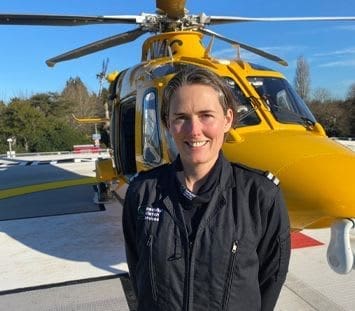
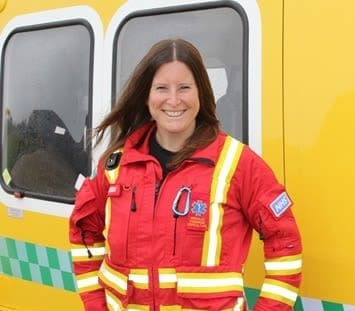
Here’s a brief summary of some of the things Lauren and I discussed when I interviewed her to find out all about the Dorset & Somerset Air Ambulance.
Q: What is the set up at the Dorset & Somerset Air Ambulance?
We have a Critical Care Team consisting of a doctor and specialist practitioner on the aircraft 19 hours a day from 0700-0200. In addition, we also have 2 cars with a solo practitioner running 10-22 hours each day in each county. We have a fabulous team of pilots and co-pilots, as well as charity staff and patient and family liaison nurses who are there to support patients after they have needed our team. Each air ambulance service operates slightly differently, we are proud to be able to provide critical care cover to the people of Dorset and Somerset 365 days a year.
Q: How are critical care paramedics different to ambulance paramedics?
Paramedics are highly trained health care professionals, who see a huge spectrum of patients and can do all the important things to save people’s lives. There are a small number of patients with critical illness or injury that require immediate interventions that are outside of the usual remit of a paramedic – such as anaesthetics, blood or surgical interventions. The critical care team with the air ambulance provide advanced level care using specialist equipment and drugs.
This can make a massive difference because some of these patients might never make it to the hospital otherwise. We do a lot of good work for a small number of people but the difference it can make to patient outcomes is significant.
Q: How is the air ambulance funded?
We are 95% funded by charitable giving. Each mission costs approximately £3,500 so we rely on the generosity of the public.
We are very lucky to have a supportive board of trustees who understand that for us, patient care comes first. They ensure that we use the charitable money in the best possible way to save lives.
Q: Do you have ongoing training?
Absolutely! Generally everything in the health service professions is subject to lifelong learning. We are supported throughout our careers, I have completed a Master’s degree since working with DSAA. We have a lot of training, all the time. We do emergency practice scenarios every shift, and cover all sorts of topics including transfers, paediatrics, ultrasound, surgical skills on our monthly team training day.
Q: What does a typical shift involve?
On the day shift we are ready for 7am. We all have parallel activities to start the day – the pilot will do checks on the helicopter while the critical care team check the kit and interior to ensure the medical equipment is as it should be. Once that is done we open the hangar doors and push the aircraft out onto the helipad.
Jobs come through on the phone from the HEMS (Helicopter Emergency Services) desk in the control room. They screen calls and identify jobs that trigger an activation for us. They give us the details they have and we get the location and map reference.
If the weather makes it impossible to go up in the air we go out in the rapid response vehicle – the car is a bridge that allows us to attend to as many jobs as we can.
Before we board the helicopter we book out the bloods, drugs and anaesthetics and we set off on the mission.
Q: What happens when you take the patient to hospital?
We complete the critical care interventions that the patient requires on scene and en route to hospital. We package the patient on a scoop stretcher and a thermal management bundle to keep them warm – hugely important for this patient group – and transfer them back to the helicopter. We secure all of the kit and pre-alert the hospital to inform them that we’re coming and what we might need on arrival. They activate the helipad lights, and a team of porters with a hospital trolley is there to meet us.
Q: Do you enjoy your job?
I absolutely love it, it’s the best job in the world. I’ve been doing it for seven years and have been a paramedic for fourteen.
I absolutely loved every shift that I did as a road paramedic, it’s variable, exciting and different every day. I was particularly interested in the resuscitation and critical care end of the spectrum, and sometimes found it difficult to know that a patient needed a specific intervention but not being able to do it in my paramedic skill set. As part of the critical care team with DSAA, I’m now able to do these things and it makes a huge difference. A lot of patients would have a very different outcome without it.
When patients come and visit us to say thank you, it’s just lovely.
You can read Helen’s brand new book Come Fly With Me here: https://mybook.to/flywithmesocial