
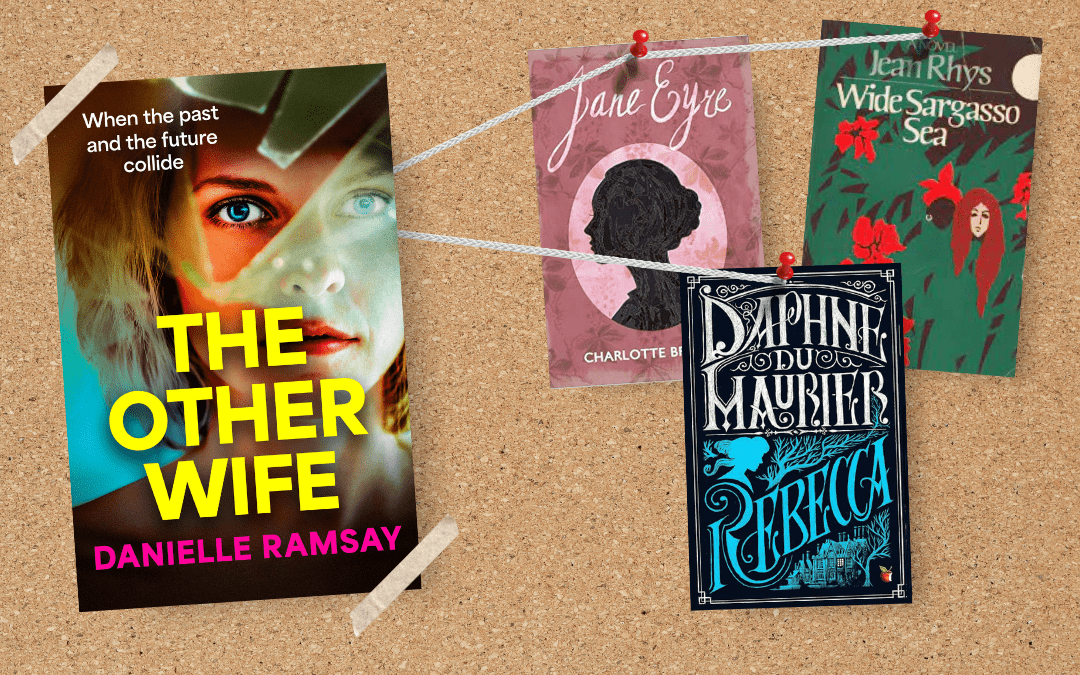
(Please note this post contains spoilers of Rebecca by Daphne du Maurier.)
The Other Wife was inspired by Daphne du Maurier’s gothic novel Rebecca, published in 1938. Rebecca is one of my all-time favourites, as is Charlotte Bronte’s Jane Eyre (1847) and the prequel to this classic by Jean Rhys, Wide Sargasso Sea (1966). The gothic novel and the concept of “the madwoman in the attic” (coined by Sandra Gilbert and Susan Gubar in their 1979 book, The Madwoman in the Attic: The Woman Writer and the Nineteenth-Century Literary Imagination) intrigued and appealed to me. The replacement second wives in Rebecca and Jane Eyre are young, respectable and crucially virtuous, dramatically contrasting with the rebellious, wayward first wives they superseded.
My narrator, Mrs Langdon, unnamed like the protagonist in Rebecca, finds herself in a world of lies and deceit, stumbling upon the forbidden west wing of her husband’s ancestral home – a Scottish castle situated on a cliff overlooking the Atlantic Ocean. She makes the shocking discovery that he was married before and similarly to Mrs de Winter and Manderley in Rebecca, the castle, and her husband are haunted by the memory of this other wife. Like the young Mrs de Winter, Mrs Langdon feels plain and dull in comparison to her husband’s beautiful first wife, Isabella Langdon, who she acknowledges is the antithesis of her in every conceivable way.
Mrs Langdon, like Mrs de Winter in Rebecca, discovers truths about her husband and his dark past. In Rebecca, the first wife, Rebecca was killed by her husband, Maxim de Winter when she told him she was pregnant by her first cousin and lover, Jack Favell. Similarly, Mrs Langdon is certain that her husband has murdered his pregnant first wife – Isabella Langdon – and hidden her body on the vast country estate.
Wide Sargasso Sea describes the background of Jane Eyre’s Mr Rochester from the point-of-view of his first wife, Antoinette Cosway, an heiress of European and Caribbean descent. The novel tells Antoinette’s unhappy journey to becoming Bronte’s “madwoman in the attic” and how her identity is stripped bare by her husband, Mr Rochester, an English gentleman. He renames her Bertha, removes her from her native Jamaica and takes her to England. Declaring her mad, he isolates her from the rest of the world in his mansion. The novel explores the inequity of power between men and women and the demise of a beautiful, young heiress, subject to her husband’s patriarchal authority, who is classed mentally ill and imprisoned. Or is it that she is deemed too wild and transgressive to fit into a patriarchal society? Rebecca was also depicted as independent and sexually deviant, the converse of Maxim de Winter’s second wife.
In Jane Eyre, Mrs Rochester is imprisoned in a third-floor room by her husband, guarded by Grace Poole, a hired nurse, just as my narrator, Mrs Langdon is imprisoned in her bedroom and watched over by her husband’s loyal housekeeper. Mr Rochester travels abroad to forget his marriage and the wife he has locked away from the world, just as Mr Langdon repeatedly disappears to London; leaving his wife isolated and hidden away with the same justification as Mr Rochester, that she is mentally unwell and is a threat to herself and others.
Mrs Langdon’s identity, like that of Mrs Rochester’s, has been stripped away, and she is left doubting her sanity. The discovery that she isn’t the first wife, and nor will she be the last forces her to act. Like her fictional predecessor Mrs Rochester, she will do whatever it takes to escape the confines of her prison and prove that her husband, James Langdon is intent on murdering her just as he murdered her predecessor, Isabella Langdon.