
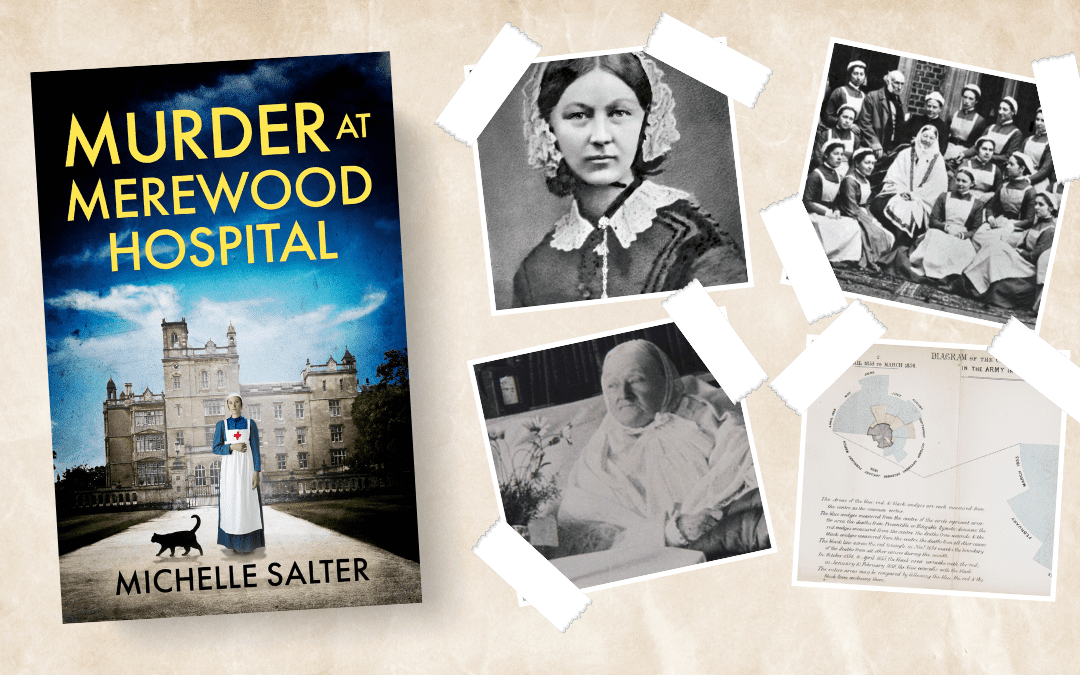
In Murder at Merewood Hospital, Sister Helen Hopgood is the last nurse in a temporary military hospital that must close – even though casualties remain.
At the start of the Great War, Helen left behind the comfort of her nursing quarters at the Nightingale School in London for a field hospital in northern France. Five years later, in June 1919, her war is still not over.
The Nightingale School at St Thomas’ Hospital opened in 1860 after a public fund for training nurses was set up in Florence Nightingale’s honour.
While Florence is mainly remembered for her revolutionary work as a nurse in the Crimean War, her influence extends way beyond the nineteenth century.
She died in 1910 at the age of 90, having written around 200 books, pamphlets and articles and over 14,000 letters. It’s this legacy that transformed the way nursing care was delivered during conflicts – and revolutionised how patients were treated in hospitals and at home.
Transforming nursing in the First World War
The First World War was the start of a new era of military nursing – and it was heavily influenced by what Florence had learned sixty years before.
As part of a Voluntary Aid Detachment, civilian women from poor and wealthy backgrounds worked with professional nurses who acted as mentors to provide nursing care for military personnel.
When Florence was growing up, nursing was only undertaken by working-class women in unsanitary conditions. Hospitals could be dangerous places, and nurses had a reputation for drunkenness.
When Florence and her team of nurses set sail for the Crimea, she wanted to make nursing a respectable profession. Her nurses wore uniforms, and she insisted doctors and military men treated them with respect.
She succeeded in making nursing a reputable occupation for women.
Pioneering the use of statistics
As well as nursing, Florence educated her readers on the importance of sanitation, hygiene – and statistics.
During the Crimean War, Florence had seen tens of thousands of soldiers die from preventable diseases. She gathered data on these deaths and used graphs to show statistics at a glance.
England and Her Soldiers is a literary account of the Crimean War by Harriet Martineau based on Florence’s statistical studies of mortality during the conflict. The two women understood that readers absorbed information faster if it was presented graphically rather than in words.
Florence’s ‘Rose Diagram’, to illustrate the rate of mortality, pioneered an approach that’s still used today.
Changing how we care for the sick
In 1860, Florence’s book Notes on Nursing became an instant bestseller. It was translated into different languages and read by Queen Victoria.
It was popular because it was written to help ordinary women care for their families. Florence explained the importance of cleanliness, warmth, fresh air, light and correct diet.
Combining physical and mental wellbeing is something we take for granted nowadays, but it was ground-breaking in Florence’s time.