
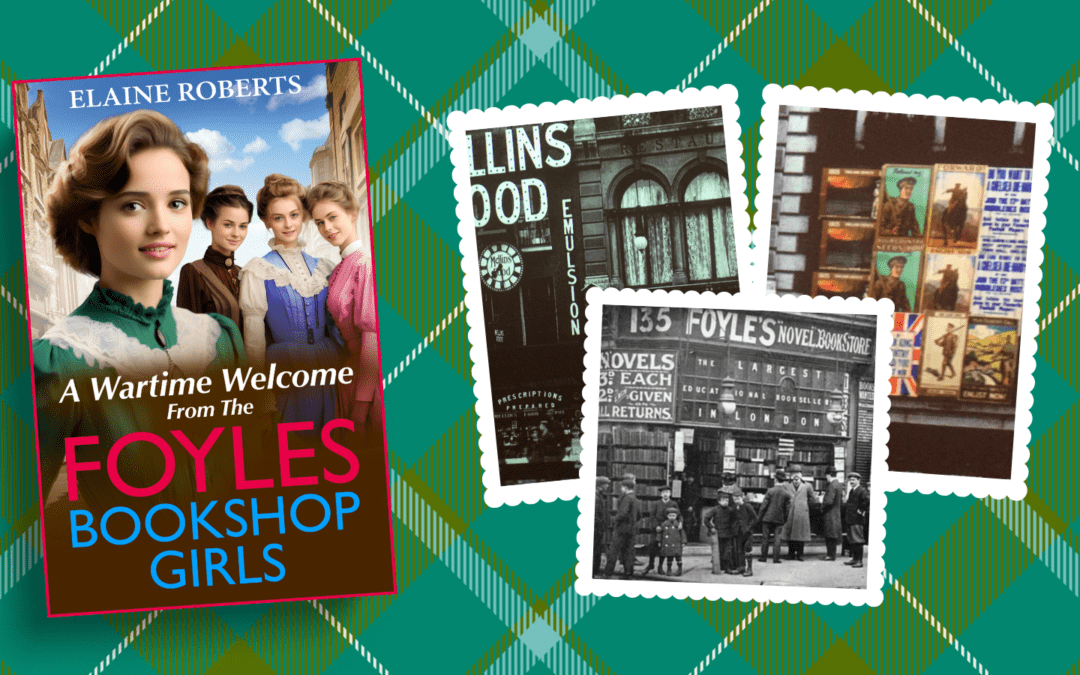
A Wartime Welcome from the Foyles Bookshop Girls by Elaine Roberts is out today! 🎉
During my research I discovered some fascinating, and sometimes quirky, information about the legendary Foyles Bookshop most of which I couldn’t use in my books because they were things that happened after World War One.
Foyles began when brothers, William and Gilbert Foyle, began selling their unwanted textbooks in 1903, after having failed their civil service exams. What started out as a kitchen table venture selling second-hand books soon became the foundations for the family-owned Foyles Bookshop, in 1906 when they took a lease on 135 Charing Cross Road in London. William Foyle had a vision of creating a bookshop for the people. They were purchasing books by the thousands and soon outgrew the premises and moved to a six-floor building at the corner of Manette Street and Charing Cross Road, across the road from the old premises. The Foyles sign age read:
THE LARGEST EDUCATIONAL BOOKSELLERS IN LONDON.
NOVELS 3d EACH 2d GIVEN ALL RETURNS.
Some relied on Foyles return system to help put food on the table when the cost of it got more expensive. It enabled children to read books without parents having to choose between books or food. Foyles’ had their own extraordinary payment system, which required customers to collect a bill from the assistant, take it to a payment booth and then return it to the assistant to collect the books. The theory was that the fewer people handling the money, the better. I discovered as part of my research about the old shop-floor signs. The payment system led to much misunderstanding and many fabulous signs erected by staff to help. One read:
READ THIS: YOU ARE NOW LEAVING THE EDUCATION DEPT.
PLEASE GET A BILL FROM THE DESK – BACK AND AROUND TO THE LEFT.
Staff were contracted for employment on a week-by-week basis, but many stayed at Foyles for years, especially when the men went off to war and lots of women took better-paid jobs in factories.
Foyles received several hundred second-hand books every day and was a welcome place for families during the war, offering an escape from reality and worries of what they were all going through. Amazingly, during World War One Foyles Bookshop escaped being damaged by the German bombings, which were relentless in London.
Credit to: Publishing Perspectives