Life in the High Alps
A long time ago I did a degree in French and German, but when I finished I couldn’t get a job. In consequence I thought it would be a good idea to go to a different country and learn another language so as to make myself more marketable. In those days I wasn’t much good at doing anything (which is probably why nobody wanted to employ me) but I finally managed to get a job teaching English in the Aosta Valley in northern Italy.
Anybody who has driven through the Mont Blanc tunnel will have driven down that valley. With the backdrop of the eternal snows of the Mont Blanc massif at one end and the wide-open plains of Piedmont to the south, it’s a stunning place to live. It is also a fascinating place for the people and the language. Or rather, the languages, plural.
The Aosta Valley is what’s known as an autonomous region. It’s part of Italy but it has its own local government, a very strong sense of identity and tradition and its own language. This is ‘Valdostano’, a patois closer to French than Italian. This was actually a help to me when I first got there because I arrived not knowing a word in Italian apart from ‘spaghetti’ (and there’s a limit to the amount of spaghetti you can eat). At least I could understand some patois and many of the locals also spoke French to me. Interestingly, there is even one side valley where people speak German. Like I say, it’s linguistically fascinating.
When I was there I had the use of a company car. This turned out to be a 20-year-old Fiat 500 with a starter motor that didn’t work so I always had to park it with its bottom in the air so that I could bump start it. Apart from that minor inconvenience, the other interesting and potentially lethal fact of life with the early Fiat 500s was that they only had three forward gears and reverse was where you would normally expect to find first gear. On several occasions I must have frightened the life out of cars behind me at traffic lights when I started shooting backwards instead of pulling away. Luckily, Fiat 500s of that era were not renowned for their acceleration, so I never actually hit anybody.
One of the most wonderful things about living at 1300 m above sea level (that’s 4200 feet) is that in the winter the the weather was almost exclusively either sunny or it’s snowing. It was very rare to have rain or those horrible grey skies that characterise an English winter. Of course, snow can bring its own problems, particularly on the road, but it also offered me for the first time in my life the opportunity to go skiing.
One of my students was heavily involved with the local ski resort of Pila and she very kindly gave me a free season ski pass (maybe I wasn’t such a bad teacher after all). In those days I was working Monday, Tuesday, Thursday and Friday so almost every Wednesday from the end of November until April I used to go skiing.
One of the disadvantages of working as a teacher was that the pay wasn’t exactly generous (so what’s new?). I managed to scrape together enough money to buy myself a pair of boots and a pair of old skis but I didn’t have money to pay for lessons, so I am completely self-taught. What this means is that I can ski down anything. In fact I can ski down slopes I would be frightened to walk or climb down, but without any style whatsoever. Still, I never caused any accidents and I never broke any bones, so I take that as a minor triumph.
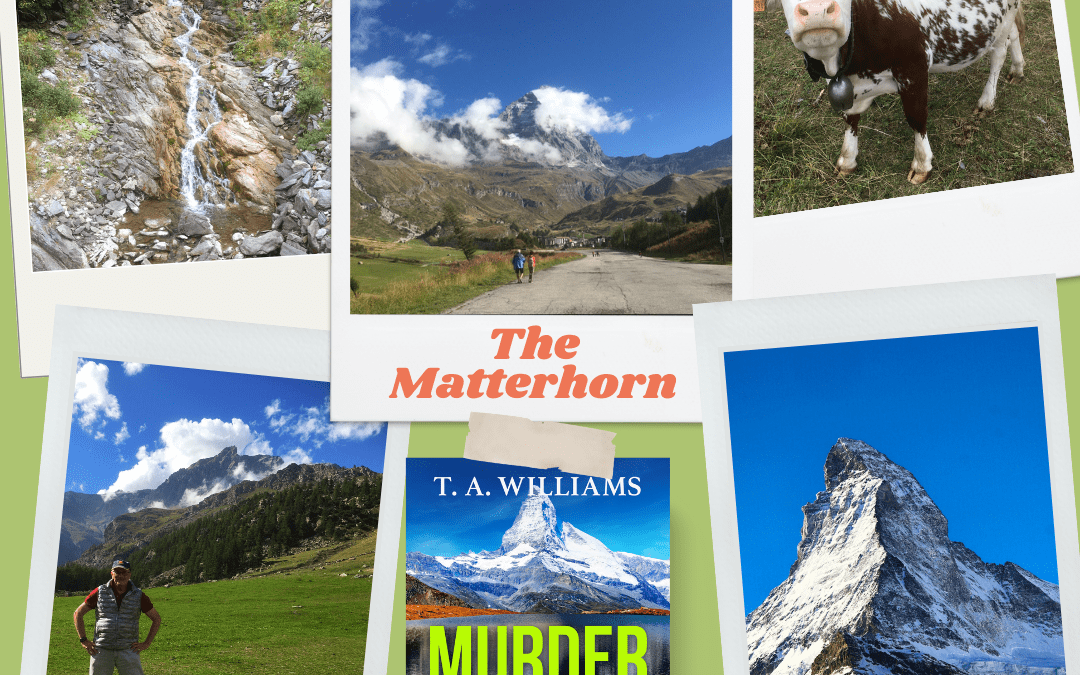
The Matterhorn occupies a special place in my heart. The very first weekend after getting to Italy the secretary at the school suggested that I should take the company car and drive up to a place called Cervinia. She told me it was a well-known ski resort and very beautiful.
I followed her advice and, remarkably, my little Fiat managed to make it all the way up to 2000 m. All the way up the valley towards Cervinia, I kept seeing an enormous pyramid-shaped lump of rock sticking up ahead of me. I asked a few people what it was called and they told me it was the ‘Cervino’. I was surprised that I had never heard of such an impressive mountain and it was finally a helpful German-speaking Swiss tourist who broke the news to me that this mountain is what we normally call by its German name, the Matterhorn.
I thoroughly enjoyed my years in the Alps and whenever I get the chance, I go back again now. Fiat 500s have changed a lot but the mountains, the lush Alpine pasture, the placid grey cows with the bells around their necks haven’t changed. If you’re ever looking for somewhere different for a summer holiday, try the Aosta Valley.
P.S. The food is amazing.
Feeling inspired by Trevor’s travels? You can pick up his latest book Murder at the Matterhorn here: https://mybook.to/matterhornsocial