
In 1900, a year before the death of Queen Victoria, single, professional women in tailored suits with crisp blouses were crossing the Atlantic on the proceeds of their employment, much to the horror of the older generation.
Several ‘M’ Class ship known as the ‘Minne’ ships, were built by the Atlantic Transport Line to accommodate this new trend in ocean travel. Running primarily between New York and London from 1881 to 1936 flying under the British Flag. These ships were the first liners to carry wireless technology and also had darkroom facilities on board.
The SS Minneapolis left New York on her maiden voyage in April 1900, arriving on the Thames for the first time on May 1, 1900 under the command of Captain Thomas F Gates, Known affectionately as “Tommy,” or “Giggles Gates” because of his infectious laugh, he was the Atlantic Transport Lines most popular captain.
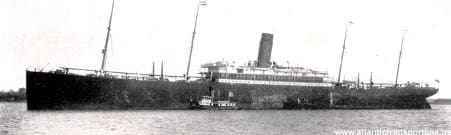
The Minneapolis photographed at Tilbury for the Illustrated London News shortly after her first appearance on the Thames in May 1900, and ran the article below
The owners, contrary to the usual practice of the steam-ship lines crossing the ocean, have avoided the modern tendency of over-decoration. Everything on the Minneapolis is of the best quality, but as simple as possible. The walls of the saloon are in light oak with allegorical figures burnt in the woodwork; an exquisite frieze in the same work, full of life and spirit, runs round the top. The dome in the ceiling gives ventilation and height to the room. The chairs and sofas are upholstered in red satin damask, and the whole effect of the saloon is bright and cheery, while also harmonious.
The library, or writing-room, is painted white and a little relief in gold. The bookcase is at present without any books in it, as they have been promised as a gift to the ship by the city of Minneapolis, in recognition of the vessel’s having been given the name of this great western city; but unfortunately the books did not reach New York in time to be put into the case. The coverings of the sofas and chairs are in a very beautifully designed tapestry, the whole idea of the room being to keep it quiet and restful. The smoking room is admirably adapted to the purpose for which it is intended. The decorations are in plain dark oak, and the seats upholstered in a very handsome red leather, all dinginess is thus avoided. Cozy corners are very suggestive of small parties sitting quietly together to have the friendly games which so materially assist in passing away the time.
No modern steamer would now be complete without suites of rooms, and the Minneapolis, being the most modern of steamers, has several suites situated on the promenade deck, which are as perfect as possible. The brass bedsteads are hung with fresh dimity curtains of pink roses on a white ground, the little window curtains all matching. Hanging cupboards and doors add to the convenience of the passengers. A bath-room is attached to each suite, and the private sitting room adjoining the bed room is charmingly fitted with a writing table and comfortable sofas.
The smoking room was considered male territory so the library became a female refuge, but were by no means the ladies’ exclusive domain. Evening entertainments were arranged by talented officers and passengers alike who performed their party pieces and staged theatrics. Passengers were called to their meals with a bugle call, the food a mixture of pretentious ‘Frenchified’ dishes and simple American and English plain cooking.
Lights were extinguished in the Saloon and the bar closed at 11 p.m., while the smoking room stayed open until 11:30 p.m.
Crews are signed on for one voyage only, at the end of which they were paid off and hoped to sign on again immediately for the next voyage. If business was slow they would have problems securing a return voyage, and should the ship they served on sink, even as a result of enemy action, their pay ended the moment she went under.
In October 1903 the celebrated actor Sir Henry Irving sailed for New York on Minneapolis with his company of 82 persons. According to a newspaper account, “many friends accompanied Sir Henry to the dock, and were entertained at a farewell luncheon on board.” In June 1907 Mark Twain travelled to England on for his last European trip on the SS Minneapolis to receive an honorary degree from Oxford University.
Between 1914 and 1916, the SS Minneapolis was used as a troop ship taking British soldiers across the Channel to France and Belgium. I knew both my grandfather and a great uncle, his younger brother by ten years, fought at the Western Front, so curiosity made me dig deeper and it appears they were both in the 2nd Border Regiment that sailed on the SS Minneapolis between Southampton and Zeebrugge in October 1914 and served in Ypres during 1915.
On 23rd March 1916, the SS Minneapolis was torpedoed by U-boat U-35 torpedoed SS Minneapolis 195 miles off the coast of Malta with the loss of 12 lives. She was being towed to Marseille but apparently, unable to tow the stricken vessel to port she sank en route.