
The most famous Regency dog was Lord Byron’s beloved Newfoundland ‘Boatswain’ (see Clifton Tomson’s portrait, commissioned by the poet). Poetry and dogs were his constant passions. When Boatswain died of rabies he was buried at Newstead Abbey, Byron’s ancestral home, under a grander and more imposing edifice than the poet’s own, and inscribed with an epitaph:
Beauty without Vanity,
Strength without Insolence,
Courage without Ferosity,
And all the Virtues of man without his Vices
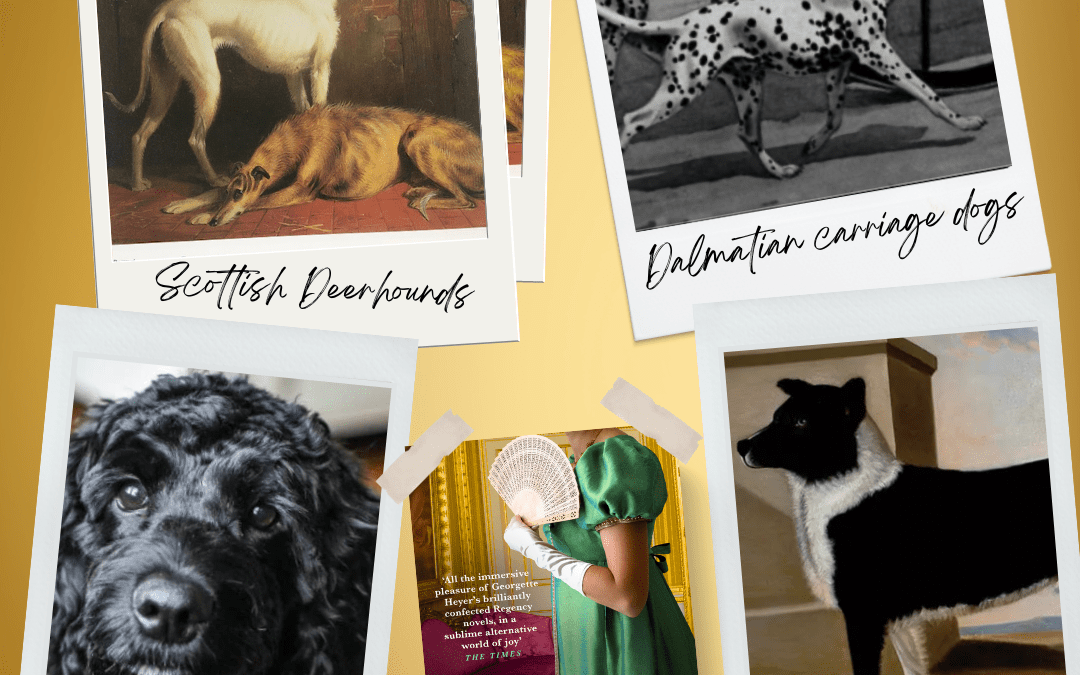
In An Unsuitable Heiress (published 22nd May) dogs play an important part in my characters’ lives. In the Regency hunting dogs lived in the kennels and stables and domestic pets lived indoors. Corinna, my heroine, has a scruffy miniature black poodle, Piro; saved from drowning, he goes everywhere with her. (see illustration) This little dog returns her love with blind loyalty and attacks the trouser leg of a carter who is intent on beating up our heroine (dressed as a young man) for stopping him abusing his horse.
But the dog who has Corinna’s heart is a deerhound, Whisky, the faithful companion of her country friend, Will Swift. This dog lives inside with his master despite being a large hunting dog (see illustration). The Scottish wolfhound had an illustrious history as valued dogs of the Scottish aristocracy and Clan leaders, perfectly built for hunting by sight across the rough terrain of the Highlands. Whisky has a soulful character and heals Corinna’s loneliness and grief after her mother dies and she is transplanted to an unsympathetic household; her prospects bleak indeed, until she takes her life into her own hands.
We meet another dog-mad character in An Unsuitable Heiress, the young French heiress (who is determined to be English) Suzette de Raval who goes daily to Hyde Park to feed the packs of stray dogs there. She is taken under Corinna’s wing when she refuses to return to Paris and marriage to a nobleman, and her lively character threads its way through the story, finding her own happy ending.
The flashiest of Regency dogs is the Dalmatian carriage dog, trained to run alongside the horses and to guard the carriage while its occupants were busy in the coaching inns along the way. The richer you were the greater the number of carriage dogs, some running as many as six. Handsome, loyal – and spotty, they drew all eyes, which is what every young Regency hero most desired.