
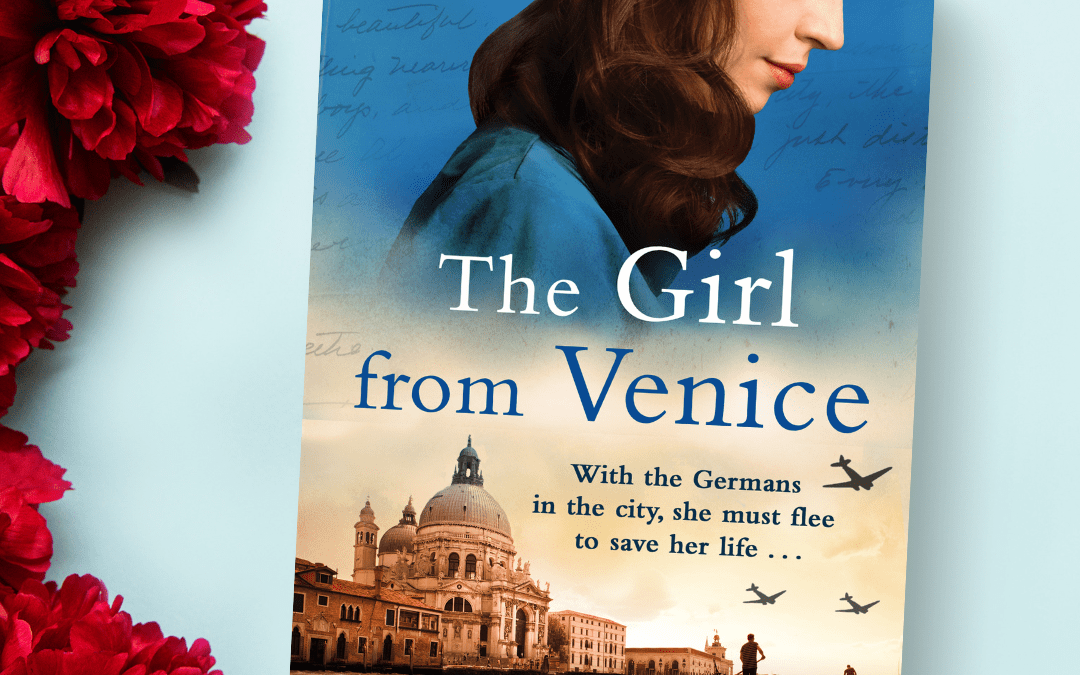
When I was in my teens, my parents renovated an old property in a small village below Monte Grappa in the Veneto region of northern Italy for holidays and their future retirement home. I used to love visiting the family of contadini farmers on the hill opposite, where I’d sit in the cosy kitchen and listen to stories about their lives. I was intrigued to learn that these kind people had hidden a Jewish couple from Venice during the war, and I based the family sheltering Lidia, the heroine of The Girl from Venice, on them.
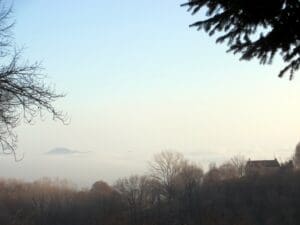
The farmhouse on the hill opposite my parents’ place
For research purposes, I decided to go and visit the memorial to the Shoah in the Venetian Ghetto before writing my book. On a hot summer’s day, I stepped into a big square and my eyes were drawn to the monument on a red brick wall opposite. After walking up to it, I gazed with sadness at the image of a train spilling out its cargo of doomed human beings, sculpted in bronze but looking as if it were wood. The faces and the details of the scene appeared to have been intentionally blurred. Carved on the surface of metal boards – made to look like the wooden slats of cattle trucks – were the names and ages of the Venetian Jews who’d been transported to Auschwitz in 1943, 246 in total, many of them only children. Each name spelt a life lost, and my heart wept for them.

The Jewish couple hidden by the farmers on the hill opposite my parents’ house kept a low profile and survived the Shoah. My heroine Lidia, on the other hand, attracted unwelcome attention and joined the partigiani based on the Monte Grappa massif, to help in the fight against the Nazi-fascists. I’d been fascinated the activities of these partisans for years and found it even more fascinating to write about them.

Monument to the partisans and the Resistance on top of Monte Grappa
I’ll never forget my initial impression of the Avenue of Martyrs in the picturesque town of Bassano del Grappa, not far from my parents’ house. The shock and the horror when I saw the trees from which, by order of the German Command, the local fascists had hung many of the partisans they’d tricked into handing themselves in. Each tree bears a ceramic photo and the name of a young man who gave his life for the freedom of others. A truly heart-breaking sight, but one that made me want to find out more about the Resistance to Nazi-fascism in this area, and write a historical novel set in those harrowing times.

Avenue of the Martyrs, Bassano del Grappa
While staying with my parents a few years ago, I met an elderly Anglo-Italian friend of my mother’s, who told me she’d been in la Resistenza in 1944. She spoke at length about the Allied mission helping the partisans, describing the parachute drops of food and weapons. Her account inspired me to carry out further research and introduce the Englishman, David, into Lidia’s story.
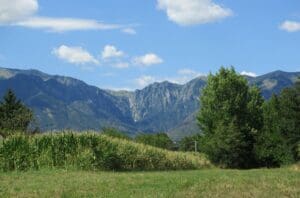
The Monte Grappa massif viewed from a field below my parents’ house.
Now I live permanently in the Veneto, where hubby and I have our forever home, I cannot help but find inspiration in the kindness of the Italians I’ve met, the beauty of their country, and the strength of their indomitable spirit. I wrote The Girl from Venice as a tribute to them. One of my reviewers said: ‘These war stories that recount of brave and principled people are necessary. They inspire and commemorate happenings which might be lost in time. And most of all, we need to realise that apathy is not the answer. “This is Venice. It won’t happen here.” One of the heroine’s father says this. But he was wrong. It can happen anywhere and everywhere.’