A blog post by Jane Dunn, the bestselling author of The Marriage Season  Now only 0.99: https://mybook.to/marriageseasonsocial
 Now only 0.99: https://mybook.to/marriageseasonsocial
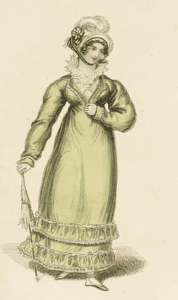
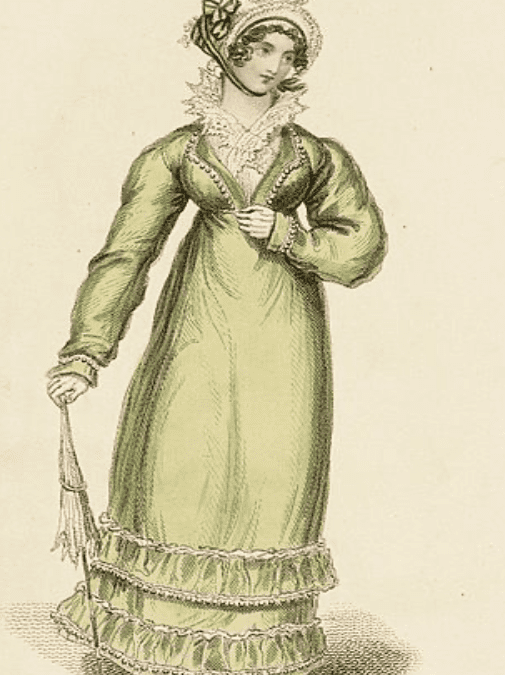
Paris always had the edge for women’s fashion but for men, London tailors were renowned as the best in the world. In my novel, The Marriage Season, the Carey sisters, Sybella and Lucie, worry about their clothes for the coming London Season. They have obtained a magazine, Records of Fashion and Court Elegance, with engravings of Parisian gowns and accessories which they hope their provincial dressmaker will copy as best she can, while they themselves adapt a few of their favourite old dresses, adding new trimmings, tucks and artificial flowers.
Setting out for London, with trunks of new morning dresses, walking dresses, riding habits, evening gowns, pelisses, spencers, opera cloaks, shawls, bonnets, gloves, fur muffs, shoes, dancing pumps and boots, the sisters feel pretty well set up until they stop to change horses at a coaching inn and see a vision of loveliness step from her coach. Lady Cleome Stafford appeared to them as a golden-haired goddess’ alighting incongruously in the midst of the Augean stables. They immediately recognise that her topaz-blue travelling cloak, lined with ermine, worn over a shimmering mother-of-pearl satin pelisse has come straight from Paris. As they watch her pick her way through the filth in lilac doeskin boots they know at once the difference between her clothes and theirs.
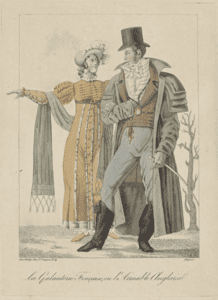
In the beginning of the 19th century, Parisian style meant higher waists, shorter skirts which showed more of the ankle and greater embellishment on the hem and sleeve. French women were also known for their enormous hats and high bonnets loaded with an orchard’s bounty of fruit and flowers. The English thought French fashion ostentatious and indecorous, but were still overawed by that unattainable je ne sais quoi. English style was more country-maid and restrained – ‘dull’ cried the French, ‘tasteful’ was the English riposte.
Although their dress sense was scorned, English women were admired for their complexions and deportment, the result it seemed of their fine horsemanship: it was in the area of riding habits that the Englishwoman stylistically ruled supreme. The smartest Parisian women patronised the legendary London tailors, John Weston, Jonathan Meyer and Schweitzer and Davidson. There they found the immaculate fit, the superb cloth and understated elegance that Beau Brummell made the template for masculine fashion for the century. The women took advantage of the tailoring skills then had their habits embellished with military style braid and frogging, exaggerating their shape and small waists as contrast to the abundance of full skirt necessary for decorum when riding and hunting side-saddle.
Despite the truce over riding habits, the French and English still lobbed insults at each other’s taste in clothes; Frenchmen were effeminate and dandified and didn’t wash; Englishmen lacked manners and suavity; Frenchwomen were over-rouged and coquettish; Englishwomen frumpy and eccentric.
There was a French fashion in undergarments that did eventually get taken up by their English cousins. Regency women wore only a chemise, with soft stays to support and elevate the breasts, and then an often flimsy muslin gown over the top. Lace-edged pantaloons initially were looked at suspiciously when they arrived on our shores. Essentially they were two tubes of fine cotton attached to a waistband but with the crotch open. The risqué element was not this but the sight of their lace edging peeping below a hem – a reminder that women had two legs which led somewhere, a thought which seemed to overheat the imaginations of men. Courtiers were horrified when Princess Charlotte insisted on wearing pantaloons and other aristocratic Englishwoman soon followed suit, until they were commonly worn by the 1820s. They then became drawers, still not closed: it wasn’t until the late19th – early 20th centuries that women’s underwear, as we know it, began to be universally worn.
Sybella and Lucie, the not quite fashionable sisters in The Marriage Season, discover that fortune, beauty and even the most exquisite Parisian wardrobe, does not happiness make. In fact, it is their own unembellished beauty, charm and courageous spirits which bring them everything their hearts desire.