
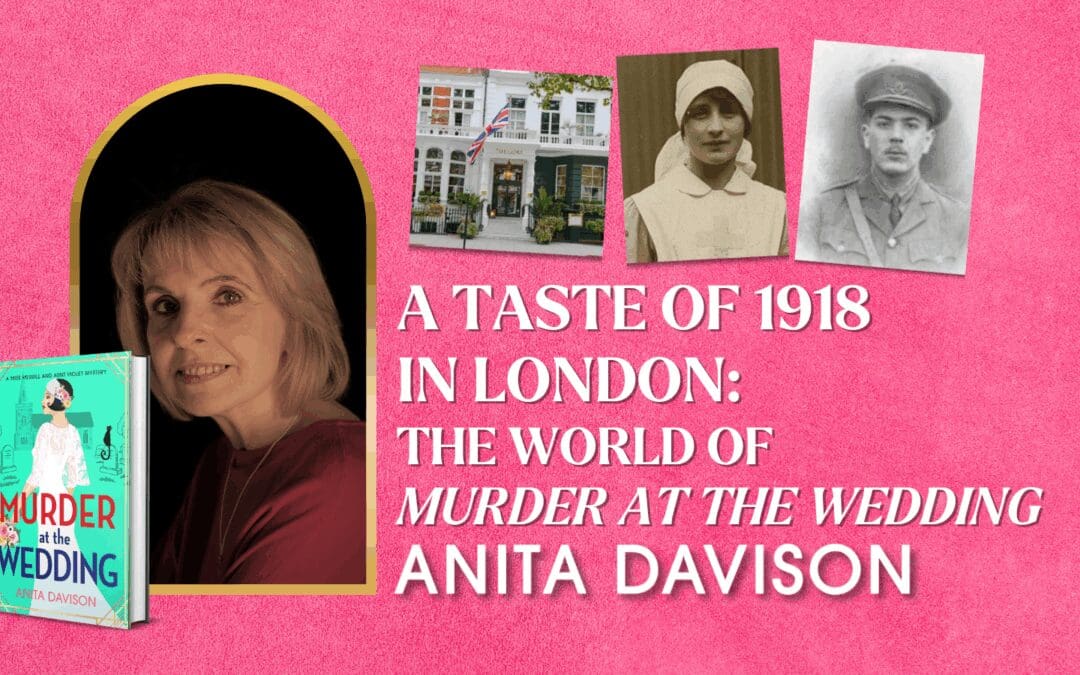
Don’t forget to start reading Anita Davison’s Murder at the Wedding, out now!
Spanish Influenza – This was the year the Spanish Flu took hold in the country. Strangely the virus did not begin in Spain, however one of its earliest victims was King Alfonso XIII of Spain, who survived but after that the words ‘Spanish Flu’ were linked to the epidemic. Spanish influenza claimed more lives than the war, e.g. in the week of 21 October 1918, 2,225 people died from the illness
Theatres – Due to the various bombing raids on London by both Zeppelins and Gotha aircraft, London’s Theatreland was badly affected at a time when morale needed to be high. Half the theatres closed while others only held matinees, so audiences did not have to travel through blacked out streets at night.
By the end of 1918 and with the war over, actors agreed a minimum wage of £2/10/0d per week. The Royal Opera House reopened, and London built its first two theatres since the conflict, the Fortune and the Vaudeville, and in addition, The Arts Theatre Club, a private members’ club for those interested in the arts, literature, and sciences, opened in Dover Street.
Women and Degrees
** In 1914, Vera Brittain went up to Sommerville in Oxford to study English Literature but being a woman was barred from being granted a degree. She took time off from studying after a year and became a VAD.
Vera worked in the Voluntary Aid Detachment as a nurse in London, Malta and in France. At Etaples, her experience nursing German prisoners of war influenced her journey towards internationalism and pacifism. Her fiancé, Roland Leighton was killed aged 20 on 23 December 1915 while the family waited him to come home for Christmas and Vera made him posthumously famous in her memoir, Testament of Youth.
In 1920 – 42 years after London and 28 years before Cambridge, Oxford allowed women to graduate with degrees and along with 29 other Sommervillians, Vera was retroactively granted her degree in Modern History.
The Representation of the People Act of 1918
The Act gave women over the age of 30 who owned or paid over £5 per annum rent on a house (or were married to someone who did) could now vote. 8.5 million women now had their say over who was in Parliament – about 2 in every 5 women in the UK.
It also said that all men over the age of 21 could vote – regardless of whether or not they owned property – and men in the armed forces could vote from the age of 19, taking number of men who could vote went from 8 million to 21 million.
The Armistice of 1918, which ended World War I, was signed on November 11, 1918 at 5:10 AM and went into effect at 11 AM.
*Green Park – London
Green Park is a 40-acre Royal Park that connects Hyde Park and St James’s Park. It’s located near Piccadilly and Buckingham Palace.
In 1660, King Charles II wanted to be able to walk all the way from Hyde Park to St James’s Park without leaving royal soil. So, he acquired land between two established parks once used as a burial ground for the lepers of St James’s Hospital, put a brick wall around it, built ice houses to cool his summer drinks and gave it the name: Upper St James’s Park. Now Green Park. However, this area was unlit and semi-rural which provided the perfect opportunity for highwaymen and robbers. Even writer Horace Walpole was held up by the infamous highwayman, James MacLaine, in The Green Park.
Queen Caroline of Ansbach made the park fashionable in the 1720’s and 1730s, installing the Queen’s Walk, commissioning English architect William Kent to build a library for her cosmopolitan collection of books.
During World War I, many Royal Parks, including Green Park, were utilised by the War Office. The lake in St James’s Park was drained and in 1916 the Ministry of Shipping buildings were erected on the lakebed. In Regent’s Park, the Army Postal Services erected reputedly the world’s largest wooden structure to handle millions of letters and parcels for the forces at the front. The parks were used for camps and military training, anti-aircraft gun stations, experimental bombing grounds, and, at Kensington Gardens the emerging science of camouflage was tested. Meanwhile, Alexandra Park and Palace accommodated firstly Belgian refugees followed by interned enemy aliens. Some parks were ploughed up for agriculture and allotments were created in others, as the German U-boat campaign started to bite, even fish were taken from park lakes.
As the war dragged on, London’s parks were used for the rest and recreation of military personnel, those on leave and those wounded, and for those entrusted with their care. In some of the larger parks, hospitals were set up, such as the South African Military Hospital in Richmond Park and St Dunstan’s Hostel for Blinded Soldiers and Sailors, which is now the site of Winfield House, the London residence of the US Ambassador in Regent’s Park.
Naturally, economies needed to be made, resulting in music and regimental bands being curtailed, and ‘bathing lakes’ either closed or operating reduced hours. Expenditure on spring bulbs was cut, and in some cases flower beds grassed over. The RHS, fearful for the horticultural industry if orders for the Royal Parks were cancelled, petitioned the government, but to no avail.
The Gore Hotel, Queens Gate, South Kensington
Constructed in 1892 by sisters Fanny and Ada Cooke, descendants of British explorer Captain Cooke., the hotel was built n the south side of Hyde Park to house visitors to the Great Exhibition of 1851 in the fashionable area of South Kensington.
With a blend of Tudor and Victorian London style and antique period pieces and original 18th- and 19th-century décor, the Gore has 50 rooms, some named after famous guests, such as the Judy Garland Suite and the Dame Nellie Melba Suite.
A gore is a narrow, triangular piece of land and the hotel was named for the Gore estate which occupied the site until it was developed by Victorian planners in the mid-19th century.
Security Service
In 1918, MI5 was part of the War Office and was responsible for counter-espionage and advising the War Office on how to deal with the police and civilians
MI5 was originally founded as the Home Section of the Secret Service Bureau, renamed MI5 between 1916 and 1918, referring to its status as the fifth branch of the Directorate of Military Intelligence. Many enemy spies and suspected spies were at the start of the war with the help of the police and to the Kaiser’s fury, most if not all German agents sent to infiltrate Britain were apprehended.
**Gustav Steinhauer, the head of the British section of German Naval Intelligence, later acknowledged that the Kaiser had been beside himself with fury when told of the ‘wholesale round-up of our secret service agents’: ‘Apparently unable to believe his ears, [he] raved and stormed for the better part of two hours about the incompetence of his so-called intelligence officers.
MI5’s staff reached a total of 844 by 1918. Including several female recruits.
In the course of the war MI5’s staff increased almost fiftyfold to reach a total of 844. Though the leadership remained overwhelmingly male, several female recruits achieved positions of greater significance than in any other British official agency or department. Miss A. W. Masterson became the first woman to manage the finances of a government office. Jane Sissmore, who joined MI5 as a sixteen-year-old secretary straight from school in 1916, progressed so rapidly that by 1924 she had qualified as a barrister and become MI5’s chief expert on Soviet affairs.
Sources:
*London Parks – Podcast https://www.royalparks.org.uk/read-watch-listen/hidden-stories-royal-parks-parks-war
**Vera Brittain – https://www.worldwar1centennial.org/index.php/articles-posts/4235-this-loneliest-hour.html
***From Professor Christopher Andrew, author of “The Defence of the Realm”.