For a long time now, I’ve wanted to write a story about my birthplace, but not having lived there for more than fifty years, I was almost afraid to tackle the subject and do it justice. When I did make a start, it was like walking down memory lane.
Huddersfield is a market town in the Colne Valley in West Yorkshire, best known for its Industrial heritage, particularly in textiles. It was still a mill town in my younger days, its ‘dark satanic mills’ providing employment for many members of my family. Before WW2, my dad was a Jacquard loom weaver at Learoyd’s on Leeds Road, and my mam tried her hand at both weaving and spinning in Brierley’s Turnbridge Mill and then Johnson’s in Moldgreen. With this in mind, I decided to set my story when Huddersfield was at the heart of the cloth-weaving industry, so I travelled back in time to 1897, and that’s how the trilogy of the Lockwood Inheritance came about. ‘A New Dawn for the Mill Girls’ is the first book.
My interest in local history began in the early 50’s in the newly built secondary School in Rawthorpe. Mr Furness, a rather good-looking young man whom all the girls were a little bit in love with, set us to work on a project about Huddersfield. ‘Before you go out into the wider world, get to know your own place well,’ he told us. We each made our own book with writings, illustrations and photographs; I still have mine. We went out on field-trips – something we’d never done before – and how amazed were we to learn that the places we took for granted had such fascinating stories. That the huge stones we clambered over when we played on Castle Hill in Almondbury were once the homes of an ancient people, and that the tower built in 1899 commemorated Queen Victoria’s Jubilee. Or that the moors where we picnicked in the school holidays were where Huddersfield’s wool trade had its beginnings. The land is hilly and unsuitable for growing crops, but is ideal for farming sheep, and the fast-flowing soft-water streams provide the water necessary for producing woollen cloth. For centuries, the industry was based in people’s homes on the uplands, in the little cottages with rows of windows in the upper storeys so that the weavers could work at their looms, weaving kersey, as they called it, for as long as there was daylight. Then, with the Industrial Revolution, the wool trade moved to large mills in the bottom of the Colne Valley, where a canal and the railway provided quick transportation of goods, and engineering and chemical works provided machinery and dyestuffs. And that’s why Huddersfield was famous for producing the best worsted cloth in the world?
One of the town’s nicest aspects is that just a mile or so from its centre, it is surrounded by beautiful countryside. Lush farmland and wild open moors against a backdrop of the Pennine mountains hold the hub of industry in their boundaries, and although the town has undergone many changes, this is still true today. Sadly, many of its fine civic buildings that were there in the time I’m writing about have been replaced by those of a less grand architecture, but the Railway Station that the poet John Betjeman declared was ‘the most splendid in England’ and the Town Hall and The George Hotel (birthplace of rugby league), and the beautiful Byram Arcade to name but a few still remain standing in all their glory. The towering mills whose tall chimneys puffed out dense smoke night and day have been converted to accommodate students who attend the university, and the remnants of the magnificent Cloth Hall that once took pride of place in the town centre have been relocated to Ravensknowle Park. To add some authenticity to my story, I tried to capture the essence of these landmarks and the events – real or imaginary – that took place there. But remember, dear reader, that my story is fiction and if some places and names don’t quite match up to your knowledge or expectation of what Huddersfield was like at the turn of the 1900’s then forgive me for using author’s licence.
I thoroughly enjoyed creating my main female character, Verity Lockwood. She is not your typical beautiful, self-assured heroine; she’s an overly tall, ungainly girl who might have been considered handsome rather than pretty, and she’s socially awkward and rather naïve. However, she more than makes up for her lack of feminine charm with her sharp mind, her kind, considerate nature, and a strong determination to overcome the unfortunate, often cruel, circumstances that she faces. Saving her family’s failing mill is her epiphany.
I like writing gritty scenes, and Verity’s father, Jebediah, gave me plenty of opportunity to portray the cruel, drunken reprobate who not only neglected his business but behaved appallingly to his daughter because she wasn’t a son.
I loved Oliver from the start. He is handsome, dependable and hard-working, and his natural integrity makes him afraid of being seen as a social climber. At the start, he believes that Verity’s interest in the mill is just a fickle whim, and she thinks he is arrogant and rude, but the longer they work together to rescue the mill from bankruptcy, the more they are attracted to each other. Developing their love affair was a pleasure.
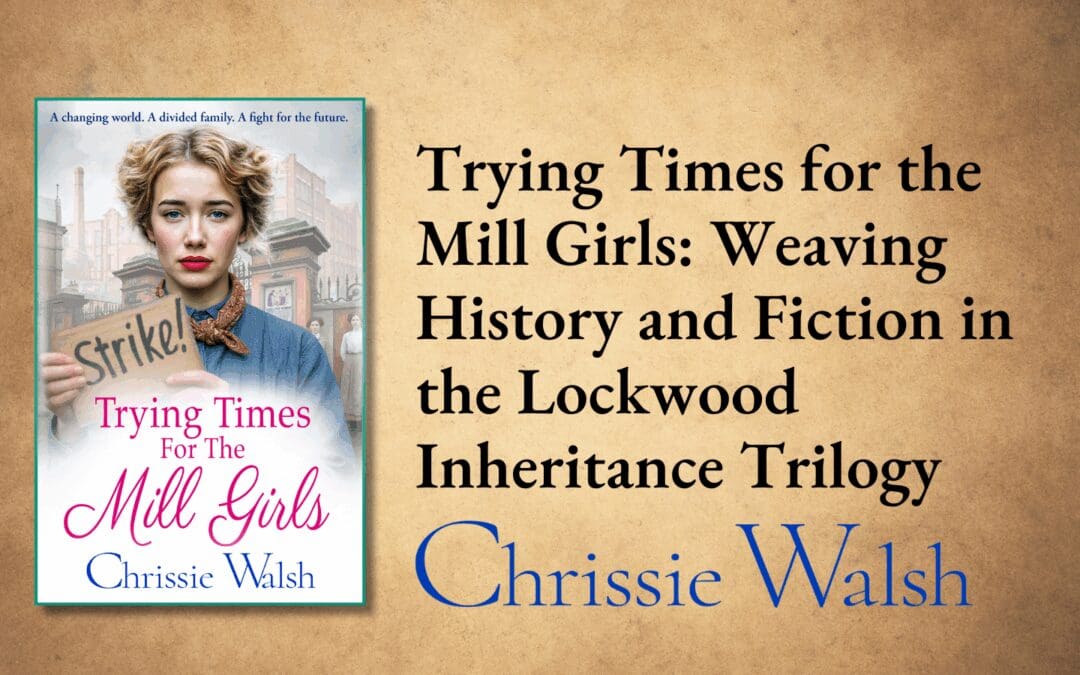
A novel come not from one idea, but from many, and sometimes it almost writes itself. When Verity gave birth to twins, a headstrong son and a placid daughter, I felt that Book 2 should be very much their story. Unwittingly, I seem to have modelled the rebellious Blaise on my temperamental brother, and Briony on my beautiful sister who sadly are no longer with us. As Blaise and Briony grow-up, their characters led me to writing about World War 1 and its terrible consequences. In my research I found many stories of heart-breaking gut-wrenching courage that almost reduced me to tears. Even so, I didn’t forget the mill girls who are very much at the centre of the novel. I did a lot of research into the lives of working women in WW1 and 2 to best tell about their grievances. These strong hard-working women wove millions of yards of khaki and blue serge to keep the British war-machine going, and at the same time they struggled to feed their families on war-time rations, and yet, they were considered less valuable than their male counterparts. The mill girls had to fight for equal pay by going on strike, and the hardships they endured without their wages were gruesome. But they persisted, and theirs were the voices that forced the mill owners to capitulate.
Finally, as with all of my stories, as the lives of the characters unfolded, I kept it real by writing about true events during that period, but mostly it is fiction of my own making. I’m looking forward to continuing the story of the Lockwood Inheritance, and Book 3 ‘The Mill Girls at War’ is still a work in process. I hope my readers enjoy reading the trilogy as much as I did when writing it.