
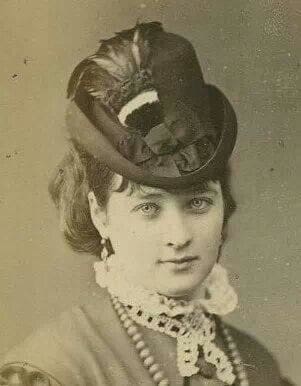
Harriet Mordaunt
(1848 – 1906)
I discovered the story of Harriet Mordaunt by accident, following a link on Twitter about King Edward VII’s sex chair – more of that later.
Because of the actions of her husband, father and lovers, Harriet spent the greater part of her life – thirty-six years – in a private asylum, years when she could have been out in the world, leading a fulfilling and active life.
The treatment of poor Harriet tells us much, not just about the chauvinism of British society at that time, but also of the dysfunctional and confused attitudes the Victorians and Edwardians demonstrated towards morality.
This was an era when it was more respectable to be declared insane than it was to be divorced; a time when the quickest and easiest way to get rid of a problematic woman was simply to pack her off to an asylum.
The true story of Harriet Mordaunt, sketched out below, is horrifying and fascinating. Biographer Nicola Shulman, Marchioness of Normanby, observed that ‘the sly unhindered crimes committed against Harriet Mordaunt make plain what rights a woman was owed in 1869.’ The fictional tale of the Room in the Attic echoes aspects of Harriet’s life in the back-stories of two of its main characters.
In the 1870s the contradiction of ‘Victorian values’ was at its height. The virtues of chastity and prudence were being preached from every pulpit, women were expected to suppress any desire that was not conducive to the happiness and wellbeing of their husbands, fathers or children, yet a staggering 80,000 prostitutes were estimated to be working in London alone.
As always, the wealthier and higher a person’s status, the less the rules seemed to apply. At least, if that person happened to be a man.
Nobody was higher up the social status ladder than Edward Albert, Prince of Wales; aka Dirty Bertie, a man who, whilst waiting to accede to the throne, whiled away the time partaking in dozens of affairs and even commissioning a ‘love seat’ to make it easier for him to have sex with one or more participants without his large belly getting in the way. The names of 55 mistresses are known, but that’s not counting prostitutes and the many more dalliances that went unrecorded.
One of Bertie’s lovers was a woman he’d known since she was a child; the fourth of eight daughters renowned for their beauty. Her name was Harriet and she had married Sir Charles Mordaunt, a baronet and Conservative MP when she was eighteen years old.
The Mordaunts were part of the Marlborough Set of party people which included the prince and his wife Princess Alexandra of Denmark. Sir Charles was often away on business, or hunting and fishing, and in his absence, Harriet continued to socialise alone.
Unfortunately, everything went wrong when Harriet gave birth to a baby girl, Violet, with sticky eyes, a symptom associated with syphilis. Harriet, fearing she might have contracted VD from one of her lovers, who included the Prince of Wales, confessed her infidelities to Sir Charles.
At that time, divorce was almost unheard-of, but Sir Charles was so angry he petitioned to end the marriage on the grounds of Harriet’s adultery. The ensuing scandal kept society riveted on both sides of the Atlantic.
In response, Harriet’s father – desperate to protect his family and perhaps fearing the scandal might taint the futures of his other children – declared Harriet insane. Two male doctors, including the Prince of Wales’s physician, diagnosed ‘puerperal mania’. One of the doctors, an expert in ‘lunacy’, claimed Lady Mordaunt’s confessions of serial adultery were typical delusions associated with her condition.
Sir Charles did not believe a word of it and claimed the madness was being feigned.
Lurid accounts in the newspapers described Harriet, now known as Mad Mordaunt, as displaying wildly unnatural behaviours. Her biographer, Nicola Shulman, believed she may have faked these behaviours under pressure from her family to avoid the disgrace divorce would bring.
In court, Prince Bertie denied adultery. Harriet was declared insane and the divorce was denied. Sir Charles offloaded his troublesome young wife, by having her incarcerated. She spent the rest of her life locked in the wards of private asylums.
Sir Charles, however, was eventually was granted a divorce and went on to marry the teenaged daughter of a vicar.
- https://en.wikipedia.org/wiki/Harriet_Mordaunt#cite_ref-14
- https://sites.udel.edu/britlitwiki/victorian-prostitution/
- https://www.curbed.com/2020/10/anyway-heres-king-edward-viis-sex-chair.html
- https://en.wikipedia.org/wiki/Nicola_Shulman
The Room In The Attic is out now!

